







Zeolite is one of the few grow-shop amendments with a serious body of agricultural science behind it. It is also sold to cannabis growers on the strength of yield figures that have never been published in full.
Both of those things are true at once, and separating them is the useful exercise. The mineral does something real. It does not do everything it is advertised to do, and it does not do it everywhere.
What Are Zeolites?
Zeolites are naturally occurring aluminosilicate minerals — frameworks of aluminum, silicon, and oxygen arranged with a rigid, porous crystal structure. Clinoptilolite is the type most commonly sold for agriculture.
Two properties make them agriculturally interesting. The structure is riddled with channels, which gives an enormous internal surface area. And the framework carries a permanent negative electrical charge, which means it attracts and holds positively charged ions.
Clinoptilolite is also stable, so a single amendment persists for years rather than needing annual replacement, and it is generally considered low in toxicity. Because it is a mined material, however, products vary in purity and composition, and fine mineral dust should not be inhaled. Agricultural-grade material should come with mineralogical and elemental analysis.
How Do Zeolites Change Soil?
Through cation exchange. Cation exchange capacity, or CEC, measures how much positive charge a soil or amendment can retain in exchangeable form.
The numbers can be striking. Clinoptilolite commonly has a CEC above 100 cmol(+)/kg, compared with 11.97 for the sandy loam examined in one 2021 study. [3] But soils vary enormously: coarse, organic-matter-poor soils may have very little exchange capacity, while clay- and organic-matter-rich soils can have considerably more. Zeolite therefore produces its largest change in a medium that starts with a low CEC, and adding it to such a soil can substantially raise its ability to retain nutrients.
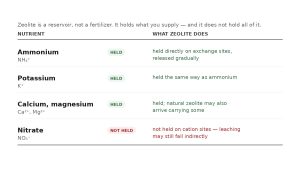
In practice that shows up mainly as nitrogen retention. Zeolite adsorbs ammonium onto its exchange sites and releases it gradually, which can reduce leaching and, in some fertilizer systems, ammonia volatilization, improving how efficiently the crop uses applied nitrogen. [3,4] It also holds potassium in the same way, and can improve water retention and pH buffering in light soils. [1,2]
What Zeolites Do Not Do
Two limits matter more than any of the marketing acknowledges.
Zeolite preferentially holds cations, not nitrate. Nitrate is negatively charged and is not retained directly on clinoptilolite’s ordinary cation-exchange sites. Zeolite can nevertheless reduce nitrate leaching indirectly in some soils, by holding ammonium before it is converted to nitrate and by changing how water moves through the medium. The reliable mechanism is direct ammonium retention, not direct nitrate capture. A crop fed predominantly with nitrate therefore receives less of zeolite’s specific nitrogen-retention benefit.
Zeolite is not a complete fertilizer. It acts principally as a reservoir rather than a source of nutrition. Natural clinoptilolite may arrive carrying some potassium, calcium, magnesium, sodium and other elements, but its composition varies by deposit. Its main agricultural value is retaining nutrients supplied from elsewhere.
There is also a question of where it helps. The agronomic literature concentrates on sandy, low-CEC soils, where there is the most to gain. A soil already rich in organic matter and holding cations well — the kind of medium described in our article on living soil — has considerably less headroom.
What About the Cannabis Trials?
Cannabis-specific evidence is sparse, but it is not absent. At least one peer-reviewed field study has tested clinoptilolite in industrial hemp. Across two growing seasons, applications of 5 and 10 tonnes per hectare reduced some of the losses in dry matter and seed-oil yield caused by water stress under different irrigation regimes. [5] That supports a role under drought conditions. It tells us nothing about cannabinoid potency or about yields of drug-type cannabis flower.
The dramatic figures that circulate — harvests nearly tripling with a 10% amendment — come from grow trials commissioned by a zeolite producer and released through company announcements rather than a peer-reviewed publication. [6] The company withheld the complete data, so the results cannot be independently examined. The plants were also grown from seed rather than as genetically identical clones, adding another source of variation. The results are not necessarily wrong, but they were strongly medium-dependent: the same trial reported a near-tripling in one growing medium and a small, statistically non-significant increase in another.
The soil science offers a plausible explanation. A low-CEC, free-draining medium has much more to gain from added exchange capacity than a well-buffered organic soil. Without the complete trial data, that cannot be established as the cause, but a dramatic response to zeolite may say as much about the starting medium as it does about the amendment.
Is It Worth Using?
The honest answer depends on the medium, not on the crop.
If you are growing in sand or another coarse, low-CEC mineral medium and losing nutrients to drainage, zeolite is a well-evidenced way to retain more of what you apply — particularly ammonium-based nitrogen. That case rests on decades of agronomy across many crops and does not need cannabis-specific data to be credible.
If you are growing in a well-built organic soil, the case is weaker, because the property zeolite supplies is one such a soil already has. And if you are not growing in soil at all — in hydroponics or aeroponics, where the nutrient solution is delivered directly and there is no medium to leach through — the problem zeolite solves does not arise.
Whichever medium you use, it pays to remember that clinoptilolite does not hold nitrate directly, and to weigh application rates against cost.
Organic matter and compost can also add exchange capacity, while bringing carbon, nutrients and biological effects that zeolite does not — the approach described in our article on regenerative cannabis farming. Zeolite adds mineral exchange capacity immediately and durably.
That is a genuinely useful thing for a mineral to do. It is a narrower thing than the marketing claims, and knowing the difference is what stops a grower buying it for the wrong soil.
References
[1] Reháková M, Čuvanová S, Dzivák M, Rimár J, Gaval’ová Z. Agricultural and agrochemical uses of natural zeolite of the clinoptilolite type. Current Opinion in Solid State and Materials Science. 2004;8(6):397-404. doi:10.1016/j.cossms.2005.04.004
[2] Polat E, Karaca M, Demir H, Onus AN. Use of natural zeolite (clinoptilolite) in agriculture. Journal of Fruit and Ornamental Plant Research. 2004;12:183-189.
[3] Palanivell P, Ahmed OH, Omar L, Abdul Majid NM. Nitrogen, phosphorus, and potassium adsorption and desorption improvement and soil buffering capacity using clinoptilolite zeolite. Agronomy. 2021;11(2):379. doi:10.3390/agronomy11020379
[4] Mondal M, Biswas B, Garai S, et al. Zeolites enhance soil health, crop productivity and environmental safety. Agronomy. 2021;11(3):448. doi:10.3390/agronomy11030448
[5] Bahador M, Tadayon MR. Investigating of zeolite role in modifying the effect of drought stress in hemp: antioxidant enzymes and oil content. Industrial Crops and Products. 2020;144:112042. doi:10.1016/j.indcrop.2019.112042
[6] Hemp grow trial shows Z1 zeolite affected cannabinoid compounds. Company announcement, 26 November 2018. ACCESS Newswire
Updated September 1, 2026: industry yield and potency claims were re-examined, unpublished company results were identified as such, and the soil-science section was rebuilt from peer-reviewed agronomy. Scientifically reviewed by Chana Frenkel, Ph.D.