





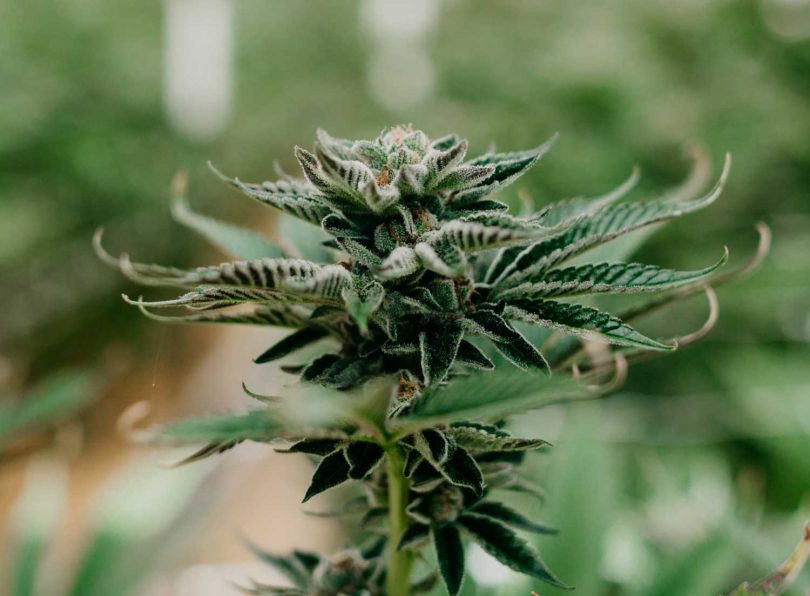

When you smell terpenes emanating from marigold flowers or hop cones or cannabis buds, you needn’t press your nose deep into the plant matter to get a decent inhalation. You may smell them across the room or the yard, down the hall, or even driving by. Terpenes drift along breezes, and that’s a wonderful thing. These terpene vapors have separated from the majority still in the flowers. And the warmer it gets, the more these fragrances will infuse the canopy.
Opposite to the desirable presence of a host of different terpenes, some products can be tainted with leftover solvent. The concentration of the solvents may be dwarfed by the bulk extract, but their presence may warrant product remediation to protect consumers.
Both analyte types require quantification; however, the molecules specifically sought might be well diluted in a sea of other molecules like cannabinoids, terpenes (when measuring solvents), flavonoids, etc. – the matrix or molecular haystack.
Gas chromatography (GC) is a traditional method for identifying and quantifying volatile molecules. Volatile just means that these molecules readily convert to gases like ethanol or acetone. Liquid and solid samples may contain species that naturally vaporize such as terpenes.
Sometimes, however, the injection of a convoluted sample matrix (a massive haystack) into a GC isn’t ideal, perhaps due to the chemicals themselves or if the volatile analytes of interest are significantly diluted by the haystack. This would lead to decreased specificity. Additionally, sampling the entire matrix could add more complexity and time to data processing and interpretation.
Headspace gas chromatography provides a way to separate the needle from the haystack. By knowing the temperature at which molecules in a sample vaporize, they can be preferentially plucked for analysis while leaving the molecular haystack behind. Some molecules will naturally go into the headspace at ambient conditions. Others can be promoted using heat such as via a heated autosampler.

As heat is applied, molecules in the liquid (or solid) sample convert to gases that fill the headspace of the vial (the space above the liquid and up to the cap). Other, freer (as in most volatile) molecules might have already risen to the top.
A real needle probes liquid samples in traditional GC, whereas, in the headspace method, the needle samples the region above the liquid (or solid), leaving many other molecules behind. Of course, if two molecules (or more) have similar vaporization points, they’ll both (all) be in the vapor, and thus, both (all) will be sampled.

This enhanced selectivity can increase specificity and accuracy, since undesirable molecules that are sampled could obscure peaks from lesser constituents or co-elute, masking their detection altogether. Headspace sampling bypasses the bulk material and increases the amount of analyte used in quantitation.
The following sections were added in August 2026. The article above is unchanged from its original publication.
Why headspace became standard for residual solvent testing
Residual solvents are close to the ideal analyte for headspace sampling, which is why it became the routine method for testing them.
The compounds being measured are highly volatile and present at trace levels inside a heavy matrix. A cannabis extract is mostly cannabinoids, which are orders of magnitude less volatile than a solvent like acetone or butane. They do produce some vapor at oven temperatures, but so little next to the solvent that they are effectively absent from what the needle draws. The solvent partitions readily into the vapor; almost nothing else does.
That gives a cleaner chromatogram, better sensitivity for the compound that matters, and no sticky cannabinoid-heavy sample passing through an inlet that would otherwise foul. For where this sits among the other methods labs use, see our guide to how cannabis labs test for terpenes.
Can a residual solvent test create the solvent it is looking for?
A residual solvent test can, under some conditions, generate a solvent that was never in the product — a finding published after this article first appeared.
In 2022, researchers heated terpene samples under conditions common to headspace autosampler routines — 140 °C for 40 minutes — and found acetone forming from every terpene tested except alpha-pinene. The effect depended on what was in the vial. Under argon, acetone stayed low. In air or oxygen, it rose sharply.
Terpinolene showed the largest change, reaching 4603.6 PPM of acetone in an oxygen atmosphere against 519.9 PPM under argon — almost nine times higher. Linalool did something similar for a different solvent, producing methanol at 651 PPM in air against 44 PPM under argon.
The solvent was not in the product. It was made from the product’s own terpenes, in the vial, during the heating step of the test.
There is a reason this has not caused visible disruption in compliance testing. The same work found that cannabinoids suppress the reaction, which explains why cannabis extracts do not report high acetone even though they can contain up to 40% terpenes. The risk sits with terpene-rich, cannabinoid-poor products: added-terpene formulations and flavor blends, which are still subject to the same residual solvent labeling rules.
The practical consequence is that oven temperature and hold time are not neutral instrument settings. They are conditions under which chemistry can happen.
Where headspace sampling falls short
The selectivity that makes the technique useful is also the source of its limits.
Anything that does not enter the headspace is invisible. That is an advantage when the invisible fraction is a cannabinoid matrix you did not want to inject, and a disadvantage when it is a heavy analyte you did. Terpenes illustrate the problem, because they span a wide volatility range: monoterpenes reach the headspace readily while heavier sesquiterpenes are far less willing, so a method tuned for one group can under-report the other. Comparisons of headspace against other sample introduction approaches are covered in our article on accelerated solvent extraction and injection techniques.
Quantitation is also matrix-dependent. Because partitioning is affected by everything else in the vial, a calibration built in one matrix may not hold in another, which is why matrix-matched standards matter more in this method than in most.
References
- Elzinga S, Dominguez-Alonzo J, Keledjian R, Douglass B, Raber JC. Acetone as artifact of analysis in terpene samples by HS-GC/MS. Molecules. 2022;27(18):6037. doi:10.3390/molecules27186037
Originally published March 8, 2020 by Jason S. Lupoi, Ph.D. Updated August 17, 2026 with additional sections on residual solvent testing, the limits of headspace selectivity, and 2022 research showing that headspace conditions can generate acetone from terpenes during analysis. The original text is unchanged.
Additions reviewed by Nani Frenkel, chief editor.
Image Credit: Papa & Barkley, Teamstudio, Perkin Elmer


