




THCV, or tetrahydrocannabivarin, is often marketed as “diet weed”: a cannabinoid said to suppress appetite without producing a conventional THC high. The biological idea is plausible, but the human evidence is much weaker than the nickname suggests.
THCV is closely related to THC but has a three-carbon side chain rather than THC’s five-carbon chain. That small structural difference changes how it interacts with cannabinoid receptors, and it is what makes THCV one of the ‘varins’. At lower concentrations, THCV can oppose activity at CB1 — the receptor through which THC stimulates appetite. At higher doses its behavior becomes more complicated and may include some CB1 activation. [1]
Why THCV Might Affect Appetite
Animal studies have reported effects on food intake, body weight and energy metabolism. Human studies have not yet shown clearly that isolated THCV suppresses appetite. A small trial in patients with type 2 diabetes found improved fasting glucose, but no reduction in appetite or body weight. [2] Another experiment found changes in brain responses to food cues, but no change in how pleasant or desirable participants said the food was. [3]
A 2025 study reported weight loss after 90 days of strips containing THCV and CBD. It included only 44 participants across three groups, and both cannabinoids were given together. Its sole author was affiliated with NeX Therapeutics, where he is founder and chief executive, although the paper declared no conflict of interest. The study therefore cannot tell us whether THCV was responsible. [4]
It is also worth knowing the history. Rimonabant, a pharmaceutical that suppressed appetite by blocking the same receptor, reached the European market in 2006 and was withdrawn in 2008 after reports of depression and suicidality. [5] THCV may differ in an important way: at lower doses, it appears to act as a neutral antagonist at CB1 rather than an inverse agonist like rimonabant, a difference thought to reduce the risk of psychiatric effects. That expectation has not been tested in long-term human trials.
Is THCV Intoxicating?
THCV is routinely miscategorized as a form of THC. [6] Low oral doses of delta-9-THCV have not produced conventional THC-like intoxication in small human studies. [7] But “not intoxicating” is still too absolute. In a dose-ranging trial, 100 and 200 mg of delta-8-THCV — a different isomer — produced mild THC-like subjective effects. [8] That same trial found something worth knowing before you buy any of this: nearly every urine sample collected eight hours after active delta-8-THCV dosing triggered a positive THC drug-screen result. [8]
Which Strains Contain THCV?
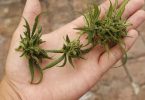
THCV-rich cultivars have been bred, including Doug’s Varin, but a cultivar name cannot guarantee its chemistry. Only a laboratory result can confirm how much THCV a sample contains.
THCV is therefore interesting, but calling it an appetite suppressant gets ahead of the evidence. The mechanism is plausible, the animal research is suggestive, and one small combination-product trial reported weight loss. What is still missing is a well-powered trial testing isolated delta-9-THCV against placebo, with appetite and body weight measured directly.
References
[1] Pertwee RG. The diverse CB1 and CB2 receptor pharmacology of three plant cannabinoids: Δ9-tetrahydrocannabinol, cannabidiol and Δ9-tetrahydrocannabivarin. Br J Pharmacol. 2008;153(2):199-215. doi:10.1038/sj.bjp.0707442
[2] Jadoon KA, Ratcliffe SH, Barrett DA, et al. Efficacy and safety of cannabidiol and tetrahydrocannabivarin on glycemic and lipid parameters in patients with type 2 diabetes: a randomized, double-blind, placebo-controlled, parallel group pilot study. Diabetes Care. 2016;39(10):1777-1786. doi:10.2337/dc16-0650
[3] Tudge L, Williams C, Cowen PJ, McCabe C. Neural effects of cannabinoid CB1 neutral antagonist tetrahydrocannabivarin on food reward and aversion in healthy volunteers. Int J Neuropsychopharmacol. 2015;18(6):pyu094. doi:10.1093/ijnp/pyu094
[4] Smith GL. Weight loss and therapeutic metabolic effects of tetrahydrocannabivarin (THCV)-infused mucoadhesive strips. Cannabis. 2025;8(1):109-120. doi:10.26828/cannabis/2024/000206
[5] Ward SJ, Raffa RB. Rimonabant redux and strategies to improve the future outlook of CB1 receptor neutral-antagonist/inverse-agonist therapies. Obesity. 2011;19(7):1325-1334. doi:10.1038/oby.2011.69
[6] Haghdoost M, Peters EN, Roberts M, Bonn-Miller MO. Tetrahydrocannabivarin is not tetrahydrocannabinol. Cannabis Cannabinoid Res. 2025;10(1):1-5. doi:10.1089/can.2024.0051
[7] Englund A, Atakan Z, Kralj A, Tunstall N, Murray R, Morrison P. The effect of five-day dosing with THCV on THC-induced cognitive, psychological and physiological effects in healthy male human volunteers: a placebo-controlled, double-blind, crossover pilot trial. J Psychopharmacol. 2016;30(2):140-151. doi:10.1177/0269881115615104
[8] Peters EN, MacNair L, Harrison A, Feldner MT, Eglit GML, Babalonis S, Turcotte C, Bonn-Miller MO. A two-phase, dose-ranging, placebo-controlled study of the safety and preliminary test of acute effects of oral Δ8-tetrahydrocannabivarin in healthy participants. Cannabis Cannabinoid Res. 2023;8(S1):S71-S82. doi:10.1089/can.2023.0038
Updated August 28, 2026: this article was substantially revised by the editorial team. The description of THCV’s receptor activity was corrected, unsupported claims about effects and cultivars were removed, and the human evidence on appetite and weight was added. Reviewed by Nani Frenkel, chief editor.