







Scientifically reviewed by Chana Frenkel, Ph.D.
MDMA PTSD research now spans six phase 2 trials, two positive phase 3 trials, an FDA decision in August 2024 that the application had not established effectiveness and safety to the agency’s standard, and a reported 2026 refiling by the drug’s developer, now called Resilient Pharmaceuticals. But the trials and the FDA are only part of what readers ask about. This article covers what the treatment actually involves, what doses the trials used, what participants say the experience is like, how strong and how durable the evidence looks, who it may not suit, what the risks are, and where it is and is not legally available as of October 2026.
The short version
- MDMA is administered during three supervised sessions inside an 18-week course of psychological support; it is not prescribed for use at home.
- Two phase 3 trials (90 and 104 participants) found bigger drops in PTSD symptoms with MDMA-assisted therapy than with placebo plus the same therapy.
- FDA advisers voted against approval in June 2024, the agency declined in August 2024, and a 2026 refiling has been reported but not confirmed.
- How long the benefits last is uncertain: small uncontrolled follow-ups suggest persistence, but the main pooled long-term paper was retracted.
- Clinical MDMA is not street ecstasy: in one large testing study, reagent tests detected MDMA in only about 60% of street samples.
What is MDMA-assisted therapy for PTSD?
Post-traumatic stress disorder is a condition in which a traumatic memory keeps forcing itself back, through intrusions, nightmares, avoidance and a nervous system stuck on high alert. Trauma-focused psychotherapy helps many people, and the two drugs approved by the FDA for PTSD, sertraline and paroxetine, help some others. Many people remain substantially symptomatic despite available treatments, which is the need these trials set out to address: the early studies emphasized treatment-resistant PTSD, while the phase 3 trials required chronic PTSD that was severe or moderate to severe.
MDMA (3,4-methylenedioxymethamphetamine) is a synthetic compound that triggers a large release of serotonin and related neurotransmitters, and is often described as an entactogen for the feelings of trust and emotional openness it produces. In this treatment it is not a pill taken at home. It is administered a few times, under continuous supervision, inside a months-long course of psychotherapy, on the hypothesis that the drug state makes it bearable to engage with traumatic memories in therapy.
Why that might work is still mostly hypothesis. One influential idea comes from mice, where a single dose reopened a window for social reward learning through oxytocin signaling in the nucleus accumbens.[1] That is preclinical work; it does not show that this is what happens in people with PTSD.
What does a treatment course involve?
In the phase 3 trials, the course ran about 18 weeks and the drug sessions were a minority of it. Participants had three 90-minute preparatory sessions, then three day-long experimental sessions about four weeks apart in which they received MDMA or placebo with a two-person therapist team present, and nine integrative therapy sessions in between and after, where the material from the drug sessions was worked through.[2]
Participants in MAPP1 had lived with PTSD for an average of 14.8 years. The main outcome, the CAPS-5, is a clinician-administered interview scored from 0 to 80; in these trials, a score of 35 or above was classified as severe PTSD.[2] Real-world programs are not bound to this exact protocol: Australia’s authorised prescribers, covered below, work under individually approved clinical protocols, which need not reproduce the phase 3 design exactly.
What dose did the trials use?
In MAPP1, the first experimental session used an initial dose of 80 mg of MDMA followed by a supplemental half-dose of 40 mg about 1.5 to 2.5 hours later; the second and third sessions used 120 mg followed by a supplemental 60 mg.[2] A session therefore involved a total of up to 120 or 180 mg of pharmaceutical MDMA, divided into an initial and a supplemental dose, with vital signs monitored under clinical supervision; the supplemental dose could also be withheld or declined.
Those numbers describe what researchers did, not what anyone should do outside a trial. They were measured doses of verified pharmaceutical MDMA, given to participants screened for heart conditions and psychiatric risk, in a monitored room. Body weight, medications, cardiovascular health and setting all change the risk, and street products often contain something other than MDMA entirely, as covered below. The trial figures carry no information about the safety of any unsupervised dose.
What do people in the trials report?
Two qualitative studies have asked participants directly. In a follow-up of one phase 2 trial, researchers interviewed 19 of its 24 participants, veterans, firefighters and police officers with chronic, treatment-resistant PTSD, about a year after treatment. All of them reported “lasting personal benefits and enhanced quality of life” that went beyond their symptom scores.[3]
A 2023 analysis examined transcripts of the integration sessions of seven participants with severe PTSD. Participants described becoming less reactive, staying with difficult feelings instead of immediately avoiding them, separating their identity from their trauma, and experiencing greater self-acceptance. Some said important changes became apparent during later integration sessions rather than during the MDMA experience itself.[4]
These are recurring reports from small samples, not guaranteed outcomes in either direction. People who found the treatment useless or harmful are also less likely to sit for a follow-up interview, which is a bias no qualitative study fully escapes.
What do other MDMA users describe?
Outside PTSD trials, people commonly describe MDMA as producing emotional warmth, closeness, empathy, trust and an unusual willingness to speak openly. Some report greater self-compassion or an ability to approach painful feelings with less fear. These recurring descriptions help explain why researchers became interested in combining MDMA with psychotherapy, but they do not show that recreational use treats PTSD.
The experience is not universally positive. Users also report stimulation, jaw clenching, nausea, sweating, anxiety, emotional overwhelm and difficulty sleeping, followed in some cases by fatigue or low mood over the following days.[5] Recreational accounts are especially difficult to interpret, because products sold as ecstasy or molly may contain uncertain doses, additional drugs or no MDMA,[6] while nightlife settings add heat, exertion, dehydration, sleep loss and other substances.
What does the full research record show?
Six phase 2 trials came first. Their pooled analysis was the statistical foundation for the phase 3 program, and it was retracted in 2024 over unethical conduct at one study site that the authors knew about and did not disclose, which makes the phase 2 record harder to lean on than it once was.[7]
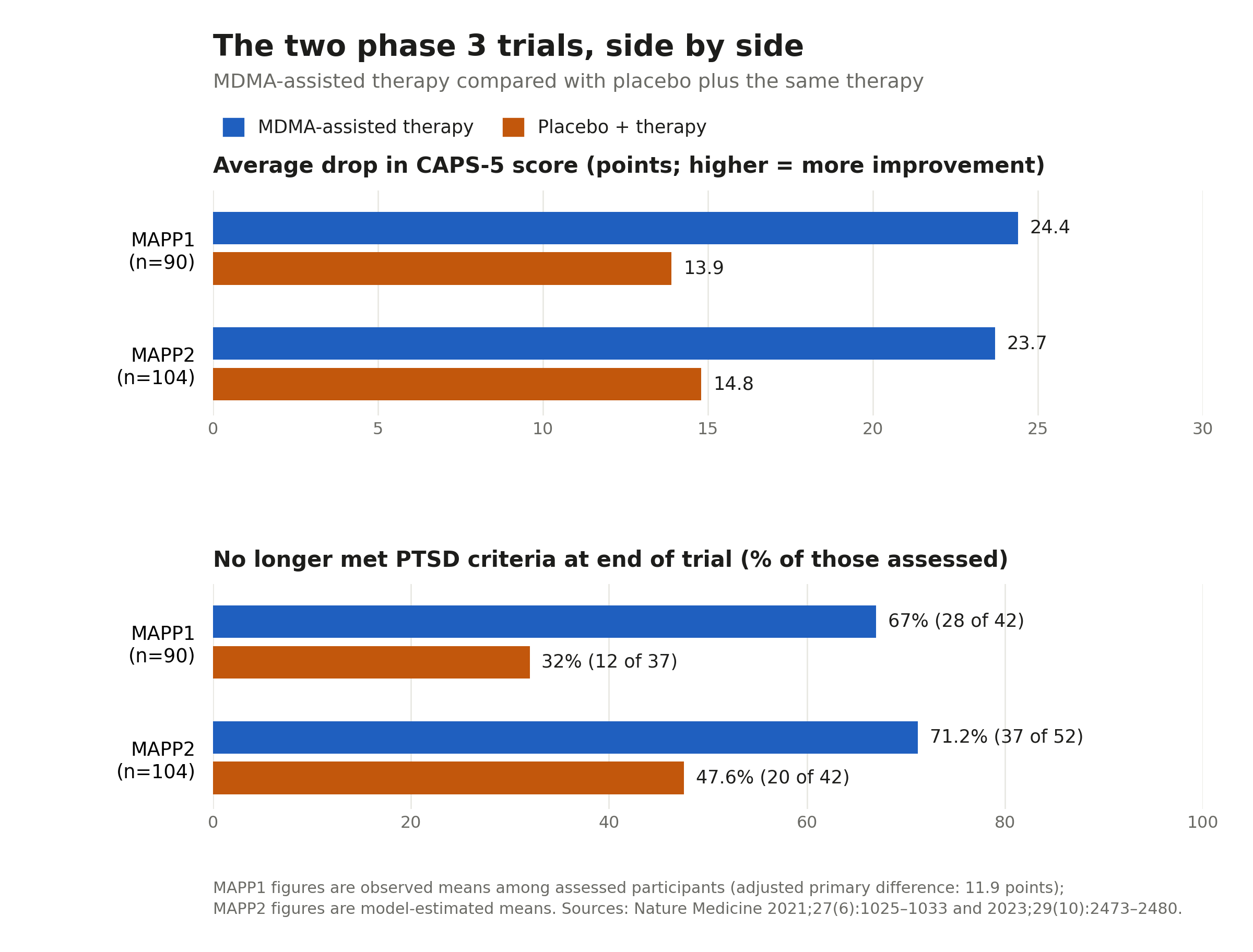
The phase 3 trials stand unretracted. MAPP1, published in Nature Medicine in 2021, randomized adults with severe PTSD to MDMA-assisted therapy or inactive placebo with the same therapy. Among participants with end-of-treatment assessments, the observed mean reductions on the clinician-rated CAPS-5 were 24.4 points with MDMA and 13.9 with placebo; the adjusted primary analysis estimated an 11.9-point between-group difference (95% CI 6.3–17.4, d = 0.91, P < 0.0001). In all, 28 of 42 assessed in the MDMA group (67%) no longer met PTSD criteria, against 12 of 37 (32%) on placebo.[2] Our January 2023 news brief covers this first trial. MAPP2, in 2023, randomized 104 people with moderate to severe PTSD: CAPS-5 scores fell 23.7 versus 14.8 points (d = 0.7, P < 0.001), and 37 of 52 (71.2%) versus 20 of 42 (47.6%) no longer met criteria.[8]
A 2024 meta-analysis pooling nine randomized trials with 297 participants found a significant reduction in CAPS severity, with response 1.59 times and remission 2.32 times more likely with MDMA, and no significant difference in the incidence of adverse events, severe adverse events or suicidal ideation between arms.[9] Pooling the studies increases statistical power, but it does not remove the shared limitations of the underlying research program, much of which came from the same development effort, and a safety analysis of 297 people is too small to exclude uncommon harms.
What the record does not contain matters as much. No trial has compared MDMA-assisted therapy head-to-head with sertraline, paroxetine or established trauma-focused psychotherapy; every comparison is against placebo plus therapy. The trials lost participants along the way, as the assessed numbers above show. And MDMA’s effects are unmistakable, so most participants could tell which arm they were in. When outcomes are symptom ratings in people who know what they received, expectation does some unknowable share of the work. We cover the same tangle for another drug in our review of how blinding and expectancy shape psilocybin depression trials.
How long do the benefits last?
Durability is uncertain rather than entirely unstudied. The phase 3 primary outcomes were measured about eight weeks after the final experimental session, 18 weeks after baseline.[2][8] Beyond that, the evidence is small and uncontrolled. A follow-up of one early trial reached 16 of its 19 participants between 17 and 74 months after their final session, an average of about 45 months, and reported sustained improvement without evidence of harm or drug dependency.[10] In April 2023 MAPS stated that phase 3 participants in an observational follow-up “demonstrated a durable response at least six months, and in some cases a year or more” after their final session.[11] But the influential pooled long-term analysis of the phase 2 trials is one of the papers retracted in 2024,[7] and the dedicated follow-up study, MPLONG, was completed in May 2024 with 186 participants. Preliminary findings have appeared in conference and FDA materials, but as of early October 2026 we found no full peer-reviewed publication of its results.[12] Because these follow-ups are observational and lack an untreated comparison group, they cannot establish how much of the improvement the treatment caused, or how often retreatment will be needed.
Who was excluded—and who may require particular caution?
The exclusion criteria show which populations the evidence does not cover well; they should not be treated as a definitive list of permanent contraindications. MAPP1 excluded anyone for whom a sympathomimetic drug could be dangerous, including uncontrolled hypertension, a history of arrhythmia, or marked QT prolongation, along with primary psychotic disorders, bipolar I disorder, dissociative identity disorder, eating disorders with active purging, major depression with psychotic features, personality disorders, current alcohol or substance use disorders, and pregnancy or lactation.[2] A history of suicidality was not an automatic exclusion; it was monitored throughout with a structured scale.[2]
Beyond the formal list, the treatment itself is an intense, hours-long altered state repeated three times, which is a real demand on someone whose nervous system is already fragile. None of this is self-screening material: eligibility in the trials was an individual medical assessment, and it would be in any clinic too.
What are the risks?
Inside the trials, the reported safety picture was reassuring. The MAPP1 authors wrote that MDMA “did not induce adverse events of abuse potential, suicidality or QT prolongation”; in MAPP2, five participants on MDMA (9.4%) and two on placebo (3.9%) had a severe treatment-emergent adverse event. “Severe” describes intensity or functional impairment; “serious” is a regulatory category involving outcomes such as hospitalization, disability or death. The investigators reported no serious treatment-emergent events and no deaths.[2][8] The 2024 meta-analysis found no significant difference in adverse events between arms.[9] But those figures are only as good as the data collection behind them, which is precisely what the FDA questioned, and advisers separately flagged cardiovascular effects and the absence of formal abuse-potential data.[13]
The drug’s ordinary acute effects are a load of their own. Outside the controlled clinical-trial literature, NIDA lists muscle tension, involuntary teeth clenching, nausea, blurred vision, faintness and chills or sweating, along with increased heart rate and blood pressure; in the days afterward, some people experience confusion, low mood, sleep problems or anxiety.[5]
Outside supervised settings the risk profile changes character. NIDA warns that at high doses MDMA can interfere with temperature regulation, and the resulting hyperthermia “can result in liver, kidney, or cardiovascular system failure or even death.”[5] The opposite attempt to manage that heat carries its own danger: hyponatremia, driven both by MDMA’s effect on fluid-regulating hormones and by drinking large amounts of water, can drop blood sodium severely enough to cause seizures, brain swelling and death.[14] Street products add adulterant risk on top.[6]
One more risk lives in the therapy room rather than the drug. The retractions trace to therapist misconduct at a phase 2 site, and sessions involve altered states and a close, dependent relationship with two therapists. Safeguards on therapist conduct are a central part of the safety question, not an add-on.[7] Long-term and repeated-dose safety, cardiovascular effects included, simply has not been measured over the horizons that would matter for a treatment people might repeat.
Is clinical MDMA the same as ecstasy?
No, and the difference is not cosmetic. The trials used verified pharmaceutical MDMA at a known dose in a screened, monitored setting. Products sold as ecstasy or molly are whatever the seller says they are. In a Johns Hopkins-led study of 529 samples submitted to the drug-checking service DanceSafe between 2010 and 2015, colorimetric reagent testing identified MDMA in only about 60% of samples; among the rest, tests indicated synthetic cathinones (“bath salts” compounds, with methylone alone in 35 samples), methamphetamine in 13, and in three cases PMA, an amphetamine linked to overdose deaths. Reagent testing is presumptive rather than full laboratory analysis, so the study cannot establish the complete composition of every sample; without comprehensive testing, purchasers cannot reliably know what these products contain.[6] Nothing in the clinical results transfers to a powder of unknown identity taken in an unscreened body in an uncontrolled setting.
Why hasn’t the FDA approved it?
On 4 June 2024 the FDA’s advisory committee voted 9 to 2 that the data did not show the therapy was effective, and 10 to 1 that its benefits did not outweigh its risks, citing functional unblinding, cardiovascular adverse events, missing abuse-potential data and doubts about data validity.[13] The Institute for Clinical and Economic Review’s panel voted 15 to 0 the same month’s end that the evidence was “not adequate to demonstrate a net health benefit” over short-term trauma-focused psychotherapies.[15] In August 2024 the agency declined approval. According to published coverage of the complete response letter, which the FDA made public in September 2025, it cited gaps in adverse-event collection, unestablished durability, and selection bias from the roughly 40% of participants who had used MDMA before; it characterized another adequately designed controlled trial as the most efficient path to resolving its concerns, and recommended that the sponsor consider an independent third-party audit of the study records.[16] The three retractions landed the same month as the rejection.[7] MAPS founder Rick Doblin maintains the data were valid: “We knew the FDA wasn’t saying no, just not yet.”[17]
2026 has moved the context without yet moving the decision. Executive Order 14401, signed 18 April, directed agencies to speed psychedelic drug review.[18] The FDA finalized its guidance on psychedelic clinical investigations on 14 July.[19] On 9 August, Psychedelic Alpha reported that Resilient Pharmaceuticals, the renamed Lykos, had refiled the application without a new phase 3 trial, reportedly leaning on outside datasets, a phase 1 safety study and an audit of the phase 3 data; neither the company nor the FDA has confirmed it.[17] The agency held a public hearing on psychedelic therapeutics on 14 September.[20] As of early October 2026, we found no public confirmation that the FDA has accepted the resubmission for review and no decision date. Other programs are moving in parallel: our report on the phase 3 LSD anxiety trial covers a result announced in August.
Where is treatment available?
Access splits into five different situations, and it is worth being precise about which is which:
- United States: not FDA-approved, and MDMA remains Schedule I, so access generally means authorized research. The VA announced a randomized trial in about 80 veterans with PTSD and alcohol use disorder in May 2026, at its Providence and West Haven sites.[21] The April 2026 executive order directs a scheduling review for Schedule I products that complete phase 3 trials and are ultimately approved by the FDA; we found no completed DEA action.[18]
- Australia: a nationwide authorised-prescriber framework since 1 July 2023. Per Psychedelic Alpha’s January 2026 review, 30 psychiatrists were authorised by the end of 2025, 87 patients had received the therapy through September 2025, and a three-dose course averages about AUD 30,000, with no serious adverse events reported in the first treated patients.[22]
- New Zealand: on 4 September 2026, the regulator Medsafe authorised two psychiatrists to prescribe pharmaceutical-grade MDMA, under approved therapeutic protocols, to adults with treatment-resistant PTSD in controlled clinical settings; MDMA itself remains an unapproved medicine there.[23]
- Canada and Switzerland: case-by-case mechanisms, not routine access. Health Canada’s Special Access Program considers individual requests involving psychedelic-assisted psychotherapy,[24] and Switzerland’s Federal Office of Public Health has issued case-by-case licenses for limited medical use of MDMA under its narcotics law since 2014.[25]
- Elsewhere: clinical research, or underground practice, which sits outside any legal framework and carries none of the screening, dosing verification or oversight that the clinical results depend on.
Full regulatory approval, authorised or case-by-case access, trial enrollment and underground practice are different things, and no country has yet granted the first.
The bottom line
MDMA-assisted therapy is one of the most promising experimental treatments in PTSD research, particularly for people who have stayed ill through conventional care. Across controlled trials, participants receiving MDMA with psychological support improved more than those receiving placebo with the same support. But the treatment is intensive, hard to blind, not risk-free, and heavily dependent on the people and setting around the drug. Positive trials provide strong evidence that MDMA adds therapeutic benefit when administered with structured psychological support; they do not yet tell us how MDMA compares with the best trauma-focused therapies, how long its benefits last, or how safely the model scales. That is what MDMA PTSD research still owes its patients, and it is roughly what the FDA asked for in 2024.[16] The VA’s randomized trial will add data of its own.[21]
Until the agency rules, the treatment remains investigational in the United States. For a different drug already in clinical use, see our conversation with Dr. Roger McIntyre on the effectiveness of ketamine.
References
- Nardou R, Lewis EM, Rothhaas R, Xu R, Yang A, Boyden E, Dölen G. Oxytocin-dependent reopening of a social reward learning critical period with MDMA. Nature. 2019;569:116-120. doi:10.1038/s41586-019-1075-9
- Mitchell JM, Bogenschutz M, Lilienstein A, et al. MDMA-assisted therapy for severe PTSD: a randomized, double-blind, placebo-controlled phase 3 study. Nat Med. 2021;27(6):1025-1033. doi:10.1038/s41591-021-01336-3
- Barone W, Beck J, Mitsunaga-Whitten M, Perl P. Perceived benefits of MDMA-assisted psychotherapy beyond symptom reduction: qualitative follow-up study of a clinical trial for individuals with treatment-resistant PTSD. J Psychoactive Drugs. 2019. doi:10.1080/02791072.2019.1580805
- Godes M, Lucas J, Vermetten E. Perceived key change phenomena of MDMA-assisted psychotherapy for the treatment of severe PTSD: an interpretative phenomenological analysis of clinical integration sessions. Front Psychiatry. 2023. doi:10.3389/fpsyt.2023.957824
- National Institute on Drug Abuse. MDMA (Ecstasy/Molly). https://nida.nih.gov/sites/default/files/mdma_1.pdf
- Saleemi S, Pennybaker SJ, Wooldridge M, Johnson MW. Who is ‘Molly’? MDMA adulterants by product name and the impact of harm-reduction services at raves. J Psychopharmacol. 2017. doi:10.1177/0269881117715596. Adulterant counts as reported in: Johns Hopkins University, 10 July 2017. https://hub.jhu.edu/2017/07/10/ecstasy-pill-testing-study
- Retraction Notes, Psychopharmacology, 2024: pooled phase 2 study-design analysis, doi:10.1007/s00213-024-06666-x; long-term follow-up of six phase 2 trials, doi:10.1007/s00213-024-06665-y; reuptake-inhibitor discontinuation analysis, doi:10.1007/s00213-024-06671-0. Reported in: Three MDMA therapy papers retracted over ethics violations. STAT, 11 August 2024. https://www.statnews.com/2024/08/11/mdma-ptsd-lykos-maps-retractions/
- Mitchell JM, Ot’alora G M, van der Kolk B, et al. MDMA-assisted therapy for moderate to severe PTSD: a randomized, placebo-controlled phase 3 trial. Nat Med. 2023;29(10):2473-2480. doi:10.1038/s41591-023-02565-4. Author Correction, 7 October 2024 (authorship only): doi:10.1038/s41591-024-03331-w
- Shahrour G, Sohail K, Elrais S, et al. MDMA-assisted psychotherapy for the treatment of PTSD: a systematic review and meta-analysis of randomized controlled trials (RCTs). Neuropsychopharmacol Rep. 2024;44(4):672-681. doi:10.1002/npr2.12485
- Mithoefer MC, Wagner MT, Mithoefer AT, Jerome L, Martin SF, Yazar-Klosinski B, Michel Y, Brewerton TD, Doblin R. Durability of improvement in post-traumatic stress disorder symptoms and absence of harmful effects or drug dependency after 3,4-methylenedioxymethamphetamine-assisted psychotherapy: a prospective long-term follow-up study. J Psychopharmacol. 2013. doi:10.1177/0269881112456611
- MAPS. MAPS-funded phase 3 research reports results from long-term observational follow-up study on MDMA-assisted therapy for PTSD. 5 April 2023. https://maps.org/2023/04/05/statement-maps-funded-phase-3-research-reports-results-from-long-term-observational-follow-up-study-on-mdma-assisted-therapy-for-ptsd/
- Long-Term Safety and Effectiveness of MDMA-Assisted Therapy for PTSD (MPLONG). ClinicalTrials.gov NCT05066282 (completed May 2024; 186 participants; no results posted). https://classic.clinicaltrials.gov/ct2/show/results/NCT05066282
- FDA Psychopharmacologic Drugs Advisory Committee meeting on MDMA-assisted therapy, 4 June 2024, as reported in: FDA advisory panel votes against MDMA-assisted therapy for PTSD. Drug Topics. https://www.drugtopics.com/view/fda-advisory-panel-votes-against-mdma-assisted-therapy-for-ptsd
- UCSF Hospital Handbook. MDMA (Ecstasy) Intoxication. https://hospitalhandbook.ucsf.edu/node/631
- Institute for Clinical and Economic Review. Final evidence report on treatment for post-traumatic stress disorder, 27 June 2024. https://icer.org/news-insights/press-releases/institute-for-clinical-and-economic-review-publishes-final-evidence-report-on-treatment-for-post-traumatic-stress-disorder/
- FDA complete response letter to Lykos Therapeutics (midomafetamine, PTSD), issued August 2024, published by FDA 4 September 2025, as described in: FDA releases CRL detailing safety concerns for MDMA-assisted therapy in PTSD. HCPLive. https://www.hcplive.com/view/fda-releases-crl-detailing-safety-concerns-mdma-assisted-therapy-ptsd ; Psychedelic Alpha, https://psychedelicalpha.com/news/breaking-fda-publishes-lykos-therapeutics-mdma-complete-response-letter-crl/ ; and Psychiatric Times, 5 September 2025. https://www.psychiatrictimes.com/view/fda-releases-complete-response-letter-on-declining-mdma-assisted-therapy-for-ptsd
- MAPS. MAPS responds to report of progress for MDMA-assisted therapy for PTSD with FDA. 10 August 2026. https://maps.org/2026/08/10/maps-responds-to-report-of-progress-for-mdma-assisted-therapy-for-ptsd-with-fda/ ; Psychedelic Alpha. Two years after rejection, Resilient quietly refiles MDMA for PTSD application. August 2026. https://psychedelicalpha.com/news/two-years-after-rejection-resilient-quietly-refiles-mdma-for-ptsd-application/
- Executive Order 14401, Accelerating Medical Treatments for Serious Mental Illness, 18 April 2026. https://www.whitehouse.gov/presidential-actions/2026/04/accelerating-medical-treatments-for-serious-mental-illness/ (Federal Register, vol. 91, no. 77, 22 April 2026)
- FDA. Psychedelic Drugs: Considerations for Clinical Investigations; Guidance for Industry; Availability. Federal Register, 14 July 2026 (document 2026-14158). https://www.federalregister.gov/documents/2026/07/14/2026-14158/psychedelic-drugs-considerations-for-clinical-investigations-guidance-for-industry-availability
- Foley Hoag LLP. FDA holds landmark public hearing on the future therapeutic use of psychedelic drugs. September 2026 (summary of the 14 September 2026 hearing). https://foleyhoag.com/news-and-insights/publications/alerts-and-updates/2026/september/fda-holds-landmark-public-hearing-on-the-future-therapeutic-use-of-psychedelic-drugs/
- US Department of Veterans Affairs. VA launches MDMA-assisted mental health therapy trial. 26 May 2026 (ClinicalTrials.gov NCT07118839). https://news.va.gov/press-room/va-launches-mdma-assisted-mental-health-therapy-trial/
- Psychedelic Alpha. Australia’s psychedelic experiment: progress, pitfalls, and what comes next. 16 January 2026. https://psychedelicalpha.com/news/australias-psychedelic-experiment-progress-pitfalls-and-what-comes-next/
- Ministry of Health NZ / Medsafe. Two psychiatrists granted approval to prescribe medicinal MDMA for PTSD. 4 September 2026. https://www.health.govt.nz/news/two-psychiatrists-granted-approval-to-prescribe-medicinal-mdma-for-ptsd
- Health Canada. Notice to stakeholders: Requests to the Special Access Program (SAP) involving psychedelic-assisted psychotherapy. https://www.canada.ca/en/health-canada/services/drugs-health-products/drug-products/announcements/requests-special-access-program-psychedelic-assisted-psychotherapy.html
- Oehen P, Gasser P. Using a MDMA- and LSD-group therapy model in clinical practice in Switzerland and highlighting the treatment of trauma-related disorders. Front Psychiatry. 2022. doi:10.3389/fpsyt.2022.863552