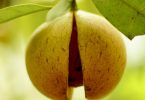







Farnesene is six closely related molecules sharing one name. The best known is (E)-beta-farnesene — not because of cannabis, but because aphids use it to warn one another.
Farnesene turns up on cannabis terpene lists as a green-apple note, and that description is accurate as far as it goes. What it misses is that farnesene is usually a minor and inconsistently reported cannabis constituent, while its best-established biology happens elsewhere: in stored apples and in the alarm signaling of insects.
What is farnesene?
Farnesene is a sesquiterpene — fifteen carbons, three isoprene units, molecular formula C₁₅H₂₄ — which puts it in the same size class as beta-caryophyllene and humulene rather than with the lighter monoterpenes.
The name covers six related compounds rather than one. Alpha-farnesene and beta-farnesene differ in where a double bond sits, and each has further variants depending on the geometry around those bonds. Alpha-farnesene accounts for four of the six; beta-farnesene for two.
That matters more here than it does for most terpenes, because the two best-documented farnesenes are different molecules with unrelated roles. (E,E)-alpha-farnesene is the compound in apple skin. (E)-beta-farnesene is the insect alarm pheromone. Writing about “farnesene” without specifying which one is like writing about “pinene” without saying alpha or beta, except with three times as many possibilities.
How much farnesene is in cannabis?
Farnesene is not usually among the dominant cannabis terpenes, but it is not invariably present only in traces. One analysis of fresh hemp flowers found (E,E)-alpha-farnesene at 1.80% of the identified volatile fraction and (E)-beta-farnesene at 0.33%; earlier studies cited in the same paper reported beta-farnesene at around 3%.
Those figures are percentages of the volatile fraction, not of the flower itself, and they vary with cultivar, plant material and analytical method. The safest description is that farnesene is generally minor and inconsistently reported.
Whether it appears on a certificate of analysis depends partly on the laboratory’s target panel, and many routine panels are not designed to distinguish all six isomers. A number reported simply as “farnesene” can confirm its presence, but it cannot tell you which isomer was measured — an important limitation when the isomers have such different biological roles, and one covered in more depth in how labs test for terpenes.
Why is farnesene associated with green apples?
Alpha-farnesene accumulates in apple skin and its waxy surface layer, which is where the green-apple association comes from.
It has a commercial consequence that has nothing to do with aroma. During cold storage, alpha-farnesene oxidizes, and its oxidation products are linked to superficial scald — a browning disorder of the skin that can render fruit unsellable. Apple storage research has studied this compound for decades for that reason, which is why the chemistry of alpha-farnesene is unusually well characterized for a minor terpene.
Is farnesene really the “death smell” of aphids?
The aphid story is nearly right, and the correction is more interesting than the original claim.
(E)-beta-farnesene is the principal component of the alarm pheromone used by most aphid pest species. When an aphid is attacked by a predator or parasitoid, it releases the compound, and nearby aphids respond by stopping feeding, walking away or dropping off the plant entirely.
So it is not emitted on death but under attack, and it is a warning to other aphids rather than a smell of dying. Some plants also release it, potentially repelling aphids, attracting the predators and parasitoids that attack them, or both. Whether that provides useful protection depends heavily on how and when the signal is released.
Can farnesene be used to protect crops?
Farnesene has been tried as a crop protectant at scale, and the result is one of the more instructive failures in agricultural biotechnology.
Researchers at Rothamsted Research spent five years engineering wheat to emit (E)-beta-farnesene, reasoning that a crop broadcasting the aphid alarm signal would defend itself. The plants produced the pheromone, but in the field they did not repel aphids.
The likely problem was timing. In nature the signal arrives in a pulse at the moment of attack. The transgenic wheat emitted it continuously, and aphids appear to habituate to a constant signal. Experiments with transgenic Arabidopsis produced the same null result and suggested the same explanation.
More recent work has taken that lesson seriously. A 2024 study placed a pyrethrum-derived synthase under its native, tissue-biased promoter in chrysanthemum. Farnesene accumulated mainly in stems and young flower buds, while increased emission occurred after mechanical damage. Aphids feeding on the plants showed measurable changes in probing and salivation.
This is not cannabis research, but it demonstrates something the terpene field frequently forgets: a molecule with a demonstrated biological function can still fail when the delivery is wrong.
Why is farnesene made in factories?
Unlike most familiar cannabis terpenes, beta-farnesene is also manufactured at industrial scale.
Commercial beta-farnesene is made by fermenting sugar with engineered yeast. Hydrogenation turns it into farnesane, a renewable jet-fuel blendstock. It is also used as a feedstock for lubricants and as a precursor to squalane, the emollient found in many moisturizers and sunscreens.
What does the research say about farnesene’s effects?
Very little research is specific to farnesene itself. Claims about antimicrobial or sedative effects generally trace to studies of whole essential oils in which farnesene was one constituent among dozens. An oil containing farnesene doing something is not evidence that farnesene caused it.
One 2022 experiment tested a commercially supplied mixture of farnesene isomers on human neutrophils in vitro and found that it inhibited calcium signaling and movement toward inflammatory signals. That is mechanistic cell evidence, not a human trial, and tells us nothing reliable about the effects of the small amounts encountered in cannabis.
There is no controlled clinical research on farnesene. Its best-established biological function remains aphid alarm signaling.
Like other sesquiterpenes, farnesene has a lower vapor pressure than the monoterpenes that dominate cannabis aroma and is therefore less prone to rapid evaporation during processing and storage. But lower volatility is not the same as stability: alpha-farnesene’s oxidation during apple storage is a clear counterexample.
For the compounds cannabis actually produces in quantity, and what the research says about each, start with our complete guide to cannabis terpenes.
References
- Kwaśnica A, Pachura N, Masztalerz K, et al. Volatile composition and sensory properties as quality attributes of fresh and dried hemp flowers (Cannabis sativa L.). Foods. 2020;9(8):1118. doi:10.3390/foods9081118
- Schepetkin IA, Özek G, Özek T, et al. Neutrophil immunomodulatory activity of farnesene, a component of Artemisia dracunculus essential oils. Pharmaceuticals. 2022;15(5):642. doi:10.3390/ph15050642
- Anet EFLJ. Synthesis of (E,Z)-α-, (Z,Z)-α-, and (Z)-β-farnesene. Australian Journal of Chemistry. 1970;23(10):2101-2108.
- Lurie S, Watkins CB. Superficial scald, its etiology and control. Postharvest Biology and Technology. 2012;65:44-60. doi:10.1016/j.postharvbio.2011.11.001
- Meadows AL, Hawkins KM, Tsegaye Y, et al. Rewriting yeast central carbon metabolism for industrial isoprenoid production. Nature. 2016;537(7622):694-697. doi:10.1038/nature19769
- Bruce TJA, Aradottir GI, Smart LE, et al. The first crop plant genetically engineered to release an insect pheromone for defence. Scientific Reports. 2015;5:11183. doi:10.1038/srep11183
- Kunert G, Reinhold C, Gershenzon J. Constitutive emission of the aphid alarm pheromone, (E)-β-farnesene, from plants does not serve as a direct defense against aphids. BMC Ecology. 2010;10:23. doi:10.1186/1472-6785-10-23
- Li J, Hu H, Ren S, et al. Aphid alarm pheromone mimicry in transgenic Chrysanthemum morifolium: insights into the potential of (E)-β-farnesene for aphid resistance. Frontiers in Plant Science. 2024;15:1373669. doi:10.3389/fpls.2024.1373669
Originally published February 6, 2023. Updated August 18, 2026 to correct the number of farnesene isomers, replace whole-oil study results that had been attributed to the compound itself, and add the crop-protection research on (E)-β-farnesene.
Reviewed by Nani Frenkel.