






Borneol is a bridged bicyclic monoterpenoid alcohol, built on the same bornane skeleton as camphor. The two compounds are close chemical relatives: camphor has a carbonyl group where borneol has a hydroxyl group, and both are strongly camphoraceous. What matters more than the structure, though, is the research record attached to this terpene — which is stranger, and in one respect stronger, than the marketing copy that usually surrounds it.
What Does Borneol Smell Like?
Borneol’s scent is usually described as camphoraceous and cooling, with earthy, balsam-like edges — mintier than camphor, funkier than eucalyptol. The “cooling” part is not a metaphor. Borneol activates TRPM8, the same cold-sensing receptor that menthol triggers, which is why it registers as cool on skin and palate without any change in temperature. [4] In a cannabis cultivar, borneol typically sits in the background of a profile, sharpening it rather than leading it.
Where Does Borneol Come From?
The name is a map reference. Borneol was historically obtained from Dryobalanops aromatica, the Borneo camphor tree, whose crystalline deposits were traded across Asia for centuries; the compound remains that tree’s main volatile constituent. [2] Under the name Bingpian, borneol has a documented history in traditional Chinese medicine stretching back well over a thousand years, both as a topical pain treatment and — more on this below — as an escort for other medicines.
Beyond cannabis and the camphor tree, borneol turns up across the herb rack: rosemary, sage, thyme, ginger, mugwort, and valerian all produce it in varying amounts.
One detail that matters more for borneol than for most terpenes: it comes in mirror-image forms. Traditional Bingpian derived from Dryobalanops is predominantly (+)-borneol; other natural sources yield the (−)-form, while synthetic borneol contains a mixture of borneol and isoborneol, a closely related diastereomer. Traditional pharmacopoeias treat natural and synthetic borneol as distinct materials, and modern studies increasingly specify which form they used — a distinction worth noticing when reading any borneol research.
Does Borneol Relieve Pain?
This is where borneol stands apart from most minor cannabis terpenes: the pain claim has actual human trial data behind it.
The preclinical foundation came first. In mice, borneol reduced pain-related behavior in standard nociception tests and reduced inflammatory cell migration, without impairing motor coordination. [1] In vitro, borneol inhibits nicotinic acetylcholine receptor activity — in one study, more potently than lidocaine, the comparison that launched a thousand “natural anesthetic” blog posts, though the finding itself comes from bovine adrenal cells in a dish, not from any clinical comparison. [2] Both the (+)- and (−)-forms also enhance the action of GABA at GABA-A receptors in vitro, which offers a mechanistic hook for borneol’s traditional reputation as a calming agent, without confirming that reputation in people. [5]
Then, in 2017, came the study that most terpenes never get. A randomized, double-blind, placebo-controlled trial in 122 patients recovering from spinal surgery found that topical (+)-borneol produced significantly greater pain relief than placebo: 66% of borneol-treated patients achieved at least a 50% reduction in pain intensity, against 35% with placebo. [4] The design was narrow, and the authors say so themselves, describing the study as preliminary — a single application of a concentrated 25% borneol solution around the sutured wound for 30 to 60 minutes, in one pain condition. It does not establish repeated use, other doses, or efficacy for other kinds of pain. The same group then traced the mechanism in mice to TRPM8 — the cooling receptor — with a downstream glutamatergic pathway in the spinal cord; their comparison with menthol, in which borneol showed a more selective mechanism and no cold hypersensitivity, was also performed in mice, not in the human trial. US food regulations permit borneol as a flavoring substance, but it is not FDA-approved as a pain treatment.
Topical delivery is the operative word throughout: the human evidence is for borneol applied to skin, not inhaled or ingested.
Does Borneol Really Open the Blood-Brain Barrier?
If you have read our article on myrcene and the blood-brain barrier, you know the punchline: the internet spent years attributing barrier-opening powers to the wrong terpene. The claim has no peer-reviewed support for myrcene. For borneol, it is a genuine, well-documented research program.
In traditional Chinese medicine, borneol belongs to a class of “orifice-opening” agents and is routinely formulated not as the active drug but as the messenger — the ingredient whose job is to carry the rest of the formula where it needs to go. Modern pharmacology has taken that role seriously. A 2017 review of two decades of work concluded that borneol transiently and reversibly increases blood-brain barrier permeability, through a combination of mechanisms: inhibition of efflux transporters such as P-glycoprotein, modulation of the tight junction proteins that seal the barrier, and enhancement of vasodilatory neurotransmitters. [6] A 2018 systematic review and meta-analysis pooled the animal studies and found consistent improvement in the brain delivery of co-administered drugs. [7]
The caveat is in that meta-analysis’s own title: the evidence is preclinical. The 58 included studies averaged only 2.8 out of 10 on the review’s quality scale; none reported blinded outcome assessment or a sample-size calculation, and heterogeneity was substantial. The authors therefore urged caution. [7] What these studies support is a repeated preclinical signal: under experimental conditions, administered borneol can alter barrier permeability and increase the brain concentrations of certain co-administered drugs. They do not establish a clinically useful effect in people, and they provide no evidence that trace borneol inhaled from cannabis escorts cannabinoids into the brain. The misattribution correction still stands, though — to the extent any terpene has earned the blood-brain barrier storyline, it is borneol, not myrcene.
What About Cancer?
An earlier version of this article described borneol as inducing cancer cells to kill themselves. That claim needs correcting on two counts. What cell-culture studies actually explored was borneol as an enhancer — increasing cancer cells’ uptake of other experimental agents and potentiating their effects, the same delivery theme that runs through the barrier research. And the most widely cited study in that area is currently flagged by its journal with an expression of concern, which is a formal signal that its findings should not be leaned on. There is no clinical evidence for borneol in cancer. The honest summary is a single sentence: borneol’s cancer research, such as it is, is early-stage cell work about drug delivery, not about borneol as a treatment.
Does Borneol Help Wounds Heal?
One line of research suggests it can, in a specific format: chitosan wound dressings loaded with (−)-borneol improved wound tissue repair in rats compared with plain chitosan films. [3] It is a preclinical finding, but a well-designed one, and it sits comfortably beside borneol’s long topical tradition — this is a compound whose strongest human evidence, from ancient Bingpian plasters to the 2017 clinical trial, points at the skin.
Which Cannabis Cultivars Contain Borneol?
Here honesty beats a list. Borneol appears as a minor constituent in some cannabis chemovars — published analytical surveys of cannabis terpenoids detect it, typically well behind the dominant terpenes [8] — and the strain lists that circulate online naming particular Haze and Kush varieties are rarely traceable to published terpene data. Cultivar names are also no guarantee of chemistry: the same name can test differently from different growers and even different harvests.
The practical advice from the original version of this article remains the best part of it: if borneol matters to you, ask for a certificate of analysis with a full terpene panel. A lab number is the only version of this information worth having.
The Bottom Line
Borneol earned its reputation the slow way — a few thousand years of topical use, followed by a modern research record that is more substantial, and more limited, than the marketing suggests. One promising controlled human trial for topical pain relief. A repeated, if methodologically limited, preclinical signal for opening the blood-brain barrier to other drugs. And a cancer story that says less than the blogs claim. For a background terpene most consumers have never heard of, that is a remarkably substantial file.
Image credit
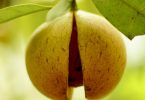
Dryobalanops aromatica — the Borneo camphor tree borneol is named for — displaying crown shyness at the Forest Research Institute Malaysia. Photo by Patrice78500 via Wikimedia Commons (public domain); cropped and color-adjusted.
References
[1] Almeida JRGS, Souza GR, Silva JC, Saraiva SRGL, Oliveira Júnior RG, Quintans JSS, Barreto RSS, Bonjardim LR, Cavalcanti SCH, Quintans Júnior LJ. Borneol, a bicyclic monoterpene alcohol, reduces nociceptive behavior and inflammatory response in mice. The Scientific World Journal. 2013;2013:808460. doi:10.1155/2013/808460
[2] Park TJ, Park YS, Lee TG, Ha H, Kim KT. Inhibition of acetylcholine-mediated effects by borneol. Biochemical Pharmacology. 2003;65(1):83–90. doi:10.1016/S0006-2952(02)01444-2
[3] Barreto RS, Quintans JS, Barreto AS, Albuquerque-Júnior RL, Galvão JG, Gonsalves JK, Nunes RS, Camargo EA, Lucca-Júnior W, Soares RC, Feitosa VLC, Quintans-Júnior LJ. Improvement of wound tissue repair by chitosan films containing (−)-borneol, a bicyclic monoterpene alcohol, in rats. International Wound Journal. 2016;13(5):799–808. doi:10.1111/iwj.12385
[4] Wang S, Zhang D, Hu J, Jia Q, Xu W, Su D, Song H, Xu Z, Cui J, Zhou M, Yang J, Xiao J. A clinical and mechanistic study of topical borneol-induced analgesia. EMBO Molecular Medicine. 2017;9(6):802–815. doi:10.15252/emmm.201607300
[5] Granger RE, Campbell EL, Johnston GAR. (+)- and (−)-borneol: efficacious positive modulators of GABA action at human recombinant α1β2γ2L GABA-A receptors. Biochemical Pharmacology. 2005;69(7):1101–1111. doi:10.1016/j.bcp.2005.01.002
[6] Zhang QL, Fu BM, Zhang ZJ. Borneol, a novel agent that improves central nervous system drug delivery by enhancing blood-brain barrier permeability. Drug Delivery. 2017;24(1):1037–1044. doi:10.1080/10717544.2017.1346002
[7] Zheng Q, Chen ZX, Xu MB, Zhou XL, Huang YY, Zheng GQ, Wang Y. Borneol, a messenger agent, improves central nervous system drug delivery through enhancing blood-brain barrier permeability: a preclinical systematic review and meta-analysis. Drug Delivery. 2018;25(1):1617–1633. doi:10.1080/10717544.2018.1486471
[8] Dei Cas M, Arnoldi S, Monguzzi L, et al. Characterization of chemotype-dependent terpenoids profile in cannabis by headspace gas-chromatography coupled to time-of-flight mass spectrometry. Journal of Pharmaceutical and Biomedical Analysis. 2021;203:114180. doi:10.1016/j.jpba.2021.114180
Updated August 26, 2026: this article was expanded with current research, including clinical evidence for topical analgesia and the blood-brain barrier literature; the reference list was corrected and a citation now under editorial review at its journal was removed. Reviewed by Nani Frenkel, chief editor.