



A Scythian tomb in southern Siberia has yielded an unusual combination: around a thousand cannabis seeds and preserved human hair containing chemical traces associated with THC. Researchers say the discovery could push evidence of cannabis use for its intoxicating effects back about 300 years. An independent toxicologist questions whether the hair proves consumption.
The findings come from Tunnug 1, a royal burial mound in the Republic of Tyva dating to the early eighth century BC. The study, led by archaeologist Gino Caspari of the University of Bern, was published in Science on November 5.
What the researchers found
The clearest chemical signal in the hair was consistent with cannabinol, or CBN, a compound that forms as THC breaks down through oxidation. The team also detected weaker signals consistent with THC, using high-resolution mass spectrometry.
That makes CBN a useful clue when studying ancient cannabis: some THC may have degraded long before a sample reaches the laboratory. But the findings cannot establish the amount consumed or whether the cannabis was inhaled or eaten.
The seeds provide a different kind of evidence. Their presence supports the researchers’ interpretation that cannabis had a place in the burial ritual. It does not, by itself, show that anyone used the plant to get high.
The question the hair cannot settle
Volker Auwärter, head of forensic toxicology at University Medical Center Freiburg, told the Associated Press that the hair analysis was “scientifically weak.” He was not involved in the study.
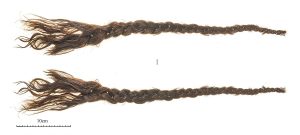
Preserved braids from the central burial chamber, in which CBN was detected. Image: Caspari et al., CC BY
His objection concerns external contamination. Hair buried alongside cannabis could acquire compounds from surrounding plant material. Detecting those compounds does not necessarily show that they entered someone’s body through consumption.
The distinction matters in modern testing too. Forensic labs get round contamination by testing for the metabolites a body makes from THC, which cannot come from outside; the Tunnug team reported the plant’s own compounds. Our guide to what cannabis hair testing can and cannot prove explains the problem.
An older clue to cannabis rituals
The discovery adds to a longer history of cannabis in Central Asian burial practices. Until now the earliest chemical evidence of smoking was about 300 years younger: cannabinoid residues on braziers from the Jirzankal cemetery in the Pamirs of western China, dated to around 500 BC. Our survey of cannabis in ancient Asia explores that history, and our look at the Mayans and Aztecs covers the plant’s ritual life on the other side of the world.
The Tunnug team is now sequencing DNA from the plant remains to investigate their origins and the history of cannabis cultivation. The plants’ THC content remains unknown.
For now, the tomb offers an important archaeological find and a disputed interpretation. Cannabis was present in the burial. Whether the people buried there consumed it for its intoxicating effects is the harder question.
Study: Caspari G, et al. Direct evidence for psychoactive cannabis use 2,800 years ago. Science. 2026;394(6824):649. doi:10.1126/science.aeg3800
Images: cannabis seeds and preserved hair from the Tunnug 1 tomb, Caspari et al., CC BY, via the University of Bern.