







Cannabutter is butter infused with cannabis, and the method is short: heat the dried flower to activate it, simmer it gently in butter, then strain and chill. Many recipes for how to make cannabutter get two steps wrong or skip them: the heating beforehand, and working out how strong the result is. Butter works because THC dissolves in fat and hardly at all in water, which makes this the simplest of the cannabis extraction methods.
What do you need?
A small batch is the sensible place to start: a quarter ounce (7 g) of dried flower to one cup (two sticks, about 225 g) of unsalted butter, plus one cup (240 ml) of water. Beyond that you need a baking sheet lined with parchment, a saucepan or slow cooker, an oven thermometer and a cooking thermometer, a fine strainer lined with cheesecloth, and a lidded container. That batch is far stronger than it sounds: up to 88 mg of THC per tablespoon with 20 percent flower.
Why do you have to decarboxylate first?
Raw flower contains mostly THCA and very little THC, and THCA becomes THC only when it is heated enough for long enough. Butter simmering with water cannot climb above 212°F (100°C), so the pan alone converts it slowly and unevenly, if at all. Heating the flower in the oven first, called cannabis decarboxylation, makes the conversion before the butter is involved.
Break the flower up by hand into small pieces, not powder, spread it in one layer on a parchment-lined baking sheet, and heat it at 240°F (115°C) for 40 minutes. That is the time and temperature of a published pharmacy method. Do not go hotter or longer to be sure, because too much heat for too long breaks THC down. Home ovens often run hotter or cooler than their dial, so check with the oven thermometer. CBD-rich flower needs the same step.
How to make cannabutter, step by step
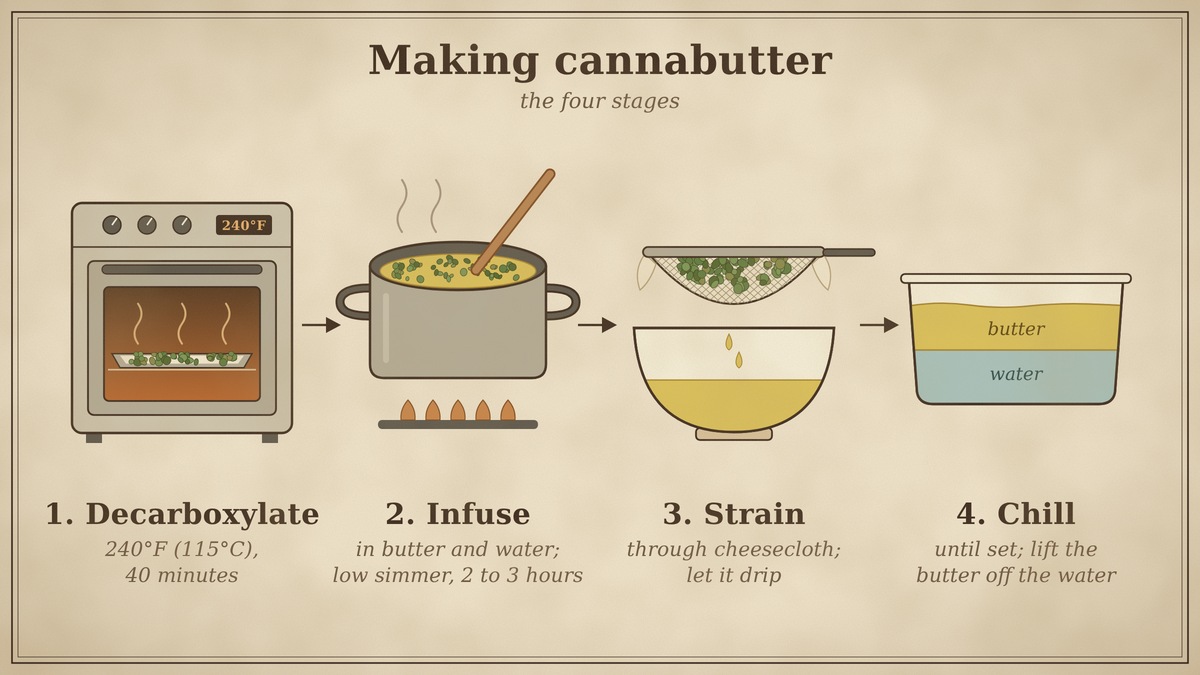
- Decarboxylate the flower: 240°F (115°C) for 40 minutes, in one layer. Let it cool.
- Melt the butter with the water in a saucepan over low heat, or in a slow cooker on low.
- Stir in the flower.
- Hold it at a low simmer, 160 to 200°F (70 to 93°C), for two to three hours, stirring now and then. Never let it boil, and top up the water if it runs low.
- Pour it through the cheesecloth-lined strainer into the container. Let it drip; squeezing hard pushes plant matter through.
- Refrigerate until the butter sets in a solid layer on top.
- Lift the butter off, discard the water underneath and pat the underside dry.
- Label it with the date and its strength, and keep it in the refrigerator, out of children’s reach.
The two to three hours in step 4 is common kitchen practice; no published study has measured it for butter. The water keeps the butter from scorching and is thrown away at the end. Countertop infusion machines automate the heating and stirring and do not change how you work out the strength.
Why did it come out weak or grassy?
Weak butter usually means the flower was not fully decarboxylated or the oven ran cool, though the flower may also have been weaker than its label: check the oven thermometer and give it the full 40 minutes. Grassy, green butter means the flower was ground to powder, the cheesecloth was squeezed or the pan boiled: break the flower by hand, let it drip and keep the heat low. Portions that vary from piece to piece mean the butter was not mixed thoroughly into the recipe: stir for longer.
How strong is your cannabutter?
You can work out the most THC the batch could hold, and that is the number to portion from. Real batches usually come in under it: a 2020 analysis of pharmacy-made olive oil preparations found that between 58 and 86 percent of the THC reached the oil. The maximum is not a guarantee, though. A label can understate the flower, and butter that is not mixed evenly through a recipe leaves some pieces stronger than others.
The sum has two steps. First, multiply the grams of flower by 1,000 and by its total THC percentage: 7 g at 20 percent is 7 × 1,000 × 0.20 = 1,400 mg. If the label lists THCA and not total THC, multiply the THCA figure by 0.877 first, because THCA gives off carbon dioxide when it converts and the THC left behind weighs less. Second, divide by the number of tablespoons of butter you ended up with. A full cup is 16 tablespoons, so 1,400 mg divided by 16 is about 88 mg per tablespoon; if you got back only 14, it is 100 mg.
| Flower, total THC | Most THC in the batch (7 g, full cup) | Per tablespoon | Per teaspoon |
|---|---|---|---|
| 10 percent | 700 mg | 44 mg | 15 mg |
| 15 percent | 1,050 mg | 66 mg | 22 mg |
| 20 percent | 1,400 mg | 88 mg | 29 mg |
| 25 percent | 1,750 mg | 109 mg | 36 mg |
A label percentage is itself approximate, so these are estimates. A lab test gives a measured figure, and even that carries a margin of error.
How much should you eat?
If you are new to edibles, start with 2.5 mg of THC or less, which is Health Canada’s advice for new consumers. One teaspoon of the 20 percent batch can hold more than ten times that. The right amount differs from person to person, and with experience you will learn what suits you; raise it a little at a time, on separate days.
Then wait. Eaten THC passes through the liver before it reaches the bloodstream, and the liver converts much of it to 11-hydroxy-THC, which is also active. That is why edibles come on more slowly than smoked cannabis and last much longer: the first effects take 30 minutes to 2 hours, the full effect can take up to four hours, and it can last as long as twelve. Wait at least two hours before taking any more, bearing in mind that the first dose may still be building, and do not drive.
The usual signs of taking too much are a rapid heart rate, dizziness, anxiety, nausea and vomiting, and they wear off as the THC does. If someone is hard to wake or struggling to breathe, call emergency services. Keep cannabutter and anything baked with it labeled, out of children’s reach and separate from ordinary food.
How do you use cannabutter?
Use it in place of part of the butter in a recipe, never all of it. Work back from the dose. One tablespoon of the 20 percent batch holds at most 88 mg, so put in one tablespoon and make up the rest of the recipe’s butter with plain butter. Mix the batter thoroughly so the THC is spread evenly, and cut the pan into 36 equal pieces: about 2.4 mg each at most. If your flower was weaker or stronger, or you got back fewer than 16 tablespoons, run the same sum with your own per-tablespoon figure.
Baking is the usual use, but a measured amount can also be stirred into a finished dish: pasta, rice, mashed potatoes, a sauce taken off the heat, or a hot drink. Add it at the end of cooking where you can, and do not fry with it. Do not spread it on toast or melt it into a drink by eye: measure it. Label whatever you make with the strength of one piece, the same as the butter itself.
How long does cannabutter last?
No published study has tested how long cannabutter keeps. The USDA’s figures for plain butter are one to two months in the refrigerator and six to nine months in the freezer, and cannabutter has been simmered with water and plant matter, so treat those as the outside limit. A cautious habit, not a tested limit, is to refrigerate what you will use within about two weeks and freeze the rest. Freeze it in portions, airtight and labeled with the date and strength, and throw it away if it smells off or shows mold. Potency also fades slowly with heat, light and air, as with stored cannabis flower.
Can you use oil instead of butter?
Yes. Coconut or olive oil works the same way. Olive oil is what the published studies used, so the 58 to 86 percent figure applies to it more directly than to butter; the maximum is worked out the same way for either. Clarified butter (ghee) is another option. Edibles can also be made from concentrates in place of flower, and the choice between BHO and CO2 extracts for edibles matters more there, because a concentrate holds several times more THC per gram than flower.
Edited by Nani Frenkel, chief editor.
Image: Felicity Tai, Pexels


