






Scientifically reviewed by Hana Frenkel, Ph.D. · Edited by Nani Frenkel, chief editor.
A cannabis flower is an agricultural product that is usually set on fire and inhaled. That combination is unusual enough that the contaminant question does not have a ready-made answer borrowed from food safety. Nobody smokes a tomato.
Contaminant testing exists because cannabis may expose the lungs to pesticide residues, microorganisms, mycotoxins and metals. Safety limits developed for food do not necessarily translate neatly to inhalation. For immunocompromised patients, the risk is documented: a 2026 clinical review identifies invasive fungal infections — particularly aspergillosis — as the clearest clinical signal, and a 2025 case used whole-genome sequencing to link a patient’s Cryptococcus infection to the organism in their own medical cannabis. [8,9] For a producer, a failed test can mean retesting, remediation or destruction — and, if the product has already shipped, a recall.
What Do Cannabis Labs Actually Test For?
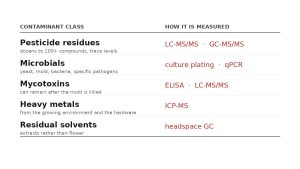
Most compliance programmes cover five broad classes, although the exact panel depends on the jurisdiction and product. [11] Each presents different analytical problems.
Pesticide residues are measured by liquid and gas chromatography coupled to tandem mass spectrometry. The analytical challenge is both breadth and matrix interference: a laboratory may have to detect dozens or more than a hundred compounds at very low concentrations, in material loaded with resins and pigments.
Microbial testing may cover total yeast and mold, total aerobic bacteria and specified pathogens such as Salmonella, Shiga toxin-producing E. coli and several Aspergillus species. Requirements vary by jurisdiction. Two methods compete: culture plating and qPCR.
Mycotoxins are the poisons some molds produce, chiefly aflatoxins and ochratoxin A. They are measured separately from the molds themselves, by ELISA or LC-MS/MS, and the reason is important: killing a mold does not necessarily remove what it has already made.
Heavy metals — usually lead, cadmium, arsenic and mercury — are measured by ICP-MS. Cannabis can take up metals from its growing environment, although accumulation varies substantially by metal, cultivar and plant tissue.
Residual solvents apply to extracts rather than flower, and are measured by headspace gas chromatography: the sample is warmed in a sealed vial and the vapor above it is analyzed, which is the standard approach for finding volatile traces in a sticky concentrate.
Many jurisdictions also require moisture or water-activity measurements and checks for foreign material. These are not contaminant classes themselves, but they help identify conditions that permit microbial growth and visible contamination.
contaminant classes methods
Why Are Pesticides the Hardest Contaminant to Regulate?
Because there is no single federal list to work from. Because marijuana remains federally controlled, the EPA has not established crop-specific pesticide tolerances for it, and states have developed their own panels and action limits. Hemp occupies a separate federal category.
The scale of that divergence is documented. A 2022 survey of every legalised US jurisdiction found 36 states and the District of Columbia between them regulating 679 contaminants — 551 pesticides, 74 solvents, 12 inorganics, 21 microbes, 5 mycotoxins and 16 others — with action levels for the same substance varying by up to four orders of magnitude. [1] A batch can be compliant in one state and fail in the state next door, on the same chemistry.
The measurement itself is difficult in a specific way. Cannabis matrix suppresses and enhances signals unpredictably, so a method validated on produce cannot simply be transferred. This is why residues sometimes appear or disappear depending on which laboratory, and which sample preparation, was used.
Remediation is an active research area rather than a solved problem. One approach uses enzymes — phosphotriesterase, which breaks down organophosphates — and we have covered the enzyme approach to pesticide breakdown in detail. Two caveats from that work are worth repeating here, because they are routinely lost in summaries: the enzyme powder is applied to growing crops, not added to an extract, and it has not been validated for cannabis specifically. Extraction-based removal is a different route, and one we examine in our article on pesticide removal during extraction.
What Does a Microbial Test Actually Prove?
Less than the pass/fail line implies, and the gap matters.
Culture plating counts organisms capable of growing under the conditions provided. Conventional qPCR detects selected DNA targets and does not, by itself, prove that the organism was alive when tested. Viability treatments and enrichment steps can narrow that gap, but the methods still answer different questions — and a producer moving between them may see numbers move for reasons that have nothing to do with the product.
The deeper limitation is what a colony count cannot see. A 2025 study of gamma-irradiated cannabis found that treatment sharply reduced microbial loads and eliminated culturable bacteria, but did not sterilize: viable spores of toxigenic Aspergillus, Penicillium and Fusarium persisted, and aflatoxins, ochratoxin, deoxynivalenol and T2 toxin remained detectable. [6] Inactivating an organism does not remove the toxins it produced beforehand, and a microbial count does not measure them. We cover that finding, and what it means for treated product, in our article on e-beam irradiation.
That is the case for testing mycotoxins as their own category rather than treating a clean microbial result as sufficient.
Where Do Heavy Metals in Cannabis Come From?
Metals can come from both the growing environment and the finished hardware.
Metals can enter cannabis from soil, irrigation water, nutrients and other cultivation inputs. Hemp is capable of taking up several metals and has been investigated for phytoremediation, although accumulation varies by metal, cultivar, soil and plant tissue.
The second source is the device. A 2025 study tracking metals through Canadian cannabis vaping products from source to inhalation used single-particle ICP-MS to detect metal particles — aluminium, cobalt, chromium, copper, nickel, tin and zinc — in the vape liquids and their aerosols, and associated them with cartridge components. [2] A product can therefore pass a heavy-metals test as bulk oil and present a different picture as a filled cartridge. That distinction — testing the input versus testing what the consumer actually inhales — is one of the sharper open questions in the field.
What Are Residual Solvents, and Why Do They Matter?
Hydrocarbon extraction uses butane, propane, or a blend; ethanol extraction uses ethanol. All of it is supposed to be removed before the product is sold, and testing exists to confirm that it was.
Risk depends on both the extraction solvent and any impurities accompanying it. Butane, propane and ethanol can remain when purging is incomplete, while more hazardous compounds such as benzene may occur as trace impurities or contaminants.
Can Contaminated Cannabis Be Cleaned Up?
Partly, and never for free.
Irradiation is one commonly used post-harvest method. It works: e-beam treatment produced roughly a five-log reduction — about a hundred-thousand-fold — in yeast and mold counts in naturally infected commercial material, [5] and irradiated hemp flower stayed below the study’s quantification limit for twelve weeks. [4]
The clearest measured chemical cost is a modest and variable reduction in terpene content, particularly among the more volatile monoterpenes. Whether losses of that size produce a perceptible aroma difference has not been established in controlled sensory testing.
The size of that cost also needs context. Examining gamma-treated cannabis, researchers found no new chromatographic peaks accounting for most of the missing terpenes, and therefore proposed that irradiation was accelerating evaporation rather than destroying the compounds — noting the effect was comparable to what short-term storage in a paper bag does to the same material. [3] That was an interpretation of their data, not a demonstrated mechanism. Our article on gamma irradiation of cannabis is the fullest treatment of that study, including the cultivar-to-cultivar variation it observed.
The comparison holds from the other direction too. Tracking irradiated and untreated hemp flower over twelve weeks, a 2025 study found total terpene losses of 24.0% and 22.3% respectively. [4] Under the conditions tested, storage time produced a larger overall change than the initial difference between treated and untreated flower.
A 2026 review comparing current cannabis sanitation technologies reaches a similar overall picture: effective microbial reduction, limited cannabis-specific quality data, and process-dependent uncertainties the published work does not resolve. [7] Microbial decontamination cannot be assumed to remove chemical toxins already present. That is the mycotoxin problem above, and it is the strongest argument for preventing contamination rather than treating it.
Does Testing Tell Us What Reaches the Lungs?
Not directly. Compliance laboratories usually measure contaminants in flower or oil before use, rather than in the smoke or aerosol the consumer inhales.
A small 2013 experiment tested three pesticides and one plant growth regulator across three smoking devices, and found that roughly 10% to 70% of the residues transferred into mainstream cannabis smoke, depending on the compound and the device — with the highest recoveries from an unfiltered glass pipe. [10] Heating may also transform contaminants into different chemicals, but the toxicology of those products remains poorly characterised. A contaminant concentration in flower is therefore not the same thing as the dose delivered to the lungs.
What Does a Passing COA Not Tell You?
Five things, and they are the reason to read a certificate of analysis rather than glance at it.
It describes a sample, not a batch. Sampling is the least-standardized step in the whole chain, and a result can only be as representative as the material that reached the lab. Even a perfect analytical method cannot compensate for an unrepresentative sample.
It reflects one moment. Microbial levels can change during storage, and filled vape hardware can introduce metals after bulk oil has already been tested.
It measures against local limits. A pass is a pass against one state’s panel and action levels. It is not a statement that nothing else is present, or that the same sample would pass elsewhere.
It usually does not record processing history. A passing microbial result seldom tells the buyer whether the batch was clean when harvested or decontaminated afterward.
It only looks for what is on the panel. Most compliance panels are targeted and cannot screen for every possible adulterant. Pine rosin is one example that would ordinarily require a separate analytical investigation — our piece on pine rosin as a contaminant in cannabis extract covers the case.
Different laboratories can also return different numbers on the same material, for reasons ranging from sample preparation to instrument calibration — a problem we examine in detail for potency in our article on why two labs give different THC results, and one that applies to contaminant panels as well.
The Bottom Line
Contaminant testing is the part of cannabis analysis where the central question is safety rather than potency or marketing. It is also the part where the standards are least settled: no federal pesticide list, competing microbial methods that answer different questions, mycotoxins that may remain after irradiation has reduced the organisms that produced them, and limits that change at the state line.
For a producer, the practical implication is that testing is a verification step, not a remediation strategy. For a patient or consumer, it is that a passing certificate is meaningful but bounded — it says a sample passed one panel on one day, which is worth knowing, and is not the same as a guarantee.
References
[1] Jameson LE, Conrow KD, Pinkhasova DV, Boulanger HL, Ha H, Jourabchian N, Johnson SA, Simeone MP, Afia IA, Cahill TM, Orser CS, Leung MCK. Comparison of state-level regulations for cannabis contaminants and implications for public health. Environmental Health Perspectives. 2022;130(9):97001. doi:10.1289/EHP11206
[2] Gajdosechova Z, Marleau-Gillette J, Polivchuk M, Kosarac I, Katuri GP, Das D, Cabecinha A, Waye A, Abramovici H. Tracking metal presence in cannabis vaping products from source to inhalation. Scientific Reports. 2025;15:31939. doi:10.1038/s41598-025-17004-2
[3] Hazekamp A. Evaluating the effects of gamma-irradiation for decontamination of medicinal cannabis. Frontiers in Pharmacology. 2016;7:108. doi:10.3389/fphar.2016.00108
[4] Goffman FD, Carrera DÁ, Latino DARS, Cronje C, Katsir L. Impact of electron beam treatment and storage duration on microbial stability and phytochemical integrity in hemp flowers. Molecules. 2025;30(17):3601. doi:10.3390/molecules30173601
[5] Jerushalmi S, Maymon M, Dombrovsky A, Freeman S. Effects of cold plasma, gamma and e-beam irradiations on reduction of fungal colony forming unit levels in medical cannabis inflorescences. Journal of Cannabis Research. 2020;2:12. doi:10.1186/s42238-020-00020-6
[6] Rani M, Kaddoura MJ, Samsatly J, Chamberland G, Jabaji S, George S. Detection of mycotoxigenic fungi and residual mycotoxins in cannabis buds following gamma irradiation. Toxins. 2025;17(11):528. doi:10.3390/toxins17110528
[7] Nestel S, Hedtfeld C, Spilker U, Ehlbeck J, Guenther S, Schnabel U. Sanitation of medical cannabis flowers (Cannabis sativa L., flos): comparing current technologies and non-thermal plasma novelties from safety and quality perspectives. Journal of Cannabis Research. 2026;8:50. doi:10.1186/s42238-026-00417-9
[8] Hughes Kramer K, Garner W, Clancy CJ, Nguyen MH. Current state of knowledge on medical cannabis use and risk for infections: a practical guide for clinicians. Clinical Infectious Diseases. 2026;ciag343. doi:10.1093/cid/ciag343
[9] Hughes Kramer K, Marino CC, Driscoll E, Cheng S, Phillips K, Volpe PJ, Clancy CJ, Nguyen MH. Medical cannabis as the source of Cryptococcus neoformans infection. Clinical Infectious Diseases. 2025;81(5):914-916. doi:10.1093/cid/ciaf431
[10] Sullivan N, Elzinga S, Raber JC. Determination of pesticide residues in cannabis smoke. Journal of Toxicology. 2013;2013:378168. doi:10.1155/2013/378168
[11] Rosas Pinto DV, Li H, Sun M. Cannabis products and contaminant detection: critical review of regulatory oversight and analytical methodologies. Cannabis and Cannabinoid Research. 2026. doi:10.1177/25785125261439008