






Reviewed by Nani Frenkel, Chief Editor
THCA diamonds look like something that shouldn’t exist in a cannabis lab — clear, faceted crystals sitting in a pool of golden terpene sauce, looking more like a mineral specimen than a drug product. The visual is striking enough that “diamond” isn’t really marketing hyperbole. The crystals form by the same basic physical process that grows rock candy in a sugar solution or salt crystals in evaporating seawater. The molecule doing the work here is just tetrahydrocannabinolic acid, and the process is more deliberate than most concentrate production.
It Starts With BHO Crude
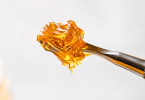
Diamond production almost always begins with a standard butane (or butane/propane) extraction — the same starting point as shatter, wax, and live resin. Where it diverges is in what happens to that crude oil immediately after extraction.
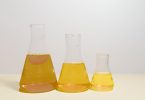
For most BHO products, the goal of purging is to remove essentially all residual solvent as quickly and completely as possible. For diamonds, that’s deliberately not the goal. Processors purge the crude oil only partially, removing much of the solvent while intentionally leaving enough for crystallization to occur inside a sealed vessel. What’s left is a supersaturated solution — a liquid holding more dissolved THCA than it could normally contain at equilibrium, similar to syrup that’s been boiled past the point where sugar would normally stay dissolved.
Supersaturation is the entire mechanism. Once the solution enters this metastable state, crystal formation becomes thermodynamically favored — THCA begins precipitating out slowly, in an ordered, repeating molecular arrangement, rather than as a disordered solid. That ordered arrangement is what makes it a crystal rather than just a clump.
THCA’s molecular structure makes it particularly well suited to forming stable crystal lattices under the right conditions. Most other cannabinoids — CBD, CBG, CBN — remain amorphous oils because their molecular structures don’t pack together as readily into an ordered solid. It’s why there are THCA diamonds but not “CBD diamonds” or “CBG diamonds” in the same sense, even though those cannabinoids are present in the same crude oil.
Why Patience Produces Bigger Crystals
The crystallization itself happens in a sealed container, left largely undisturbed, often for days to several weeks. This is the step that separates a rushed batch from a genuinely impressive one.
How quickly the solution changes during this sealed curing period determines how many nucleation sites develop at once. Inside a sealed vessel, crystallization is driven not by evaporation but by changes in solubility as the system slowly reaches equilibrium — pressure shifts and solvent redistribution alter the conditions under which THCA remains dissolved. Rapid changes trigger many nucleation points simultaneously, producing a large number of small crystals (often called “sugar” or “sauce” diamonds, since they resemble wet sand or coarse sugar). Slow, controlled changes favor fewer nucleation points, giving each one more material to draw from and more time to grow — producing the large, single-crystal diamonds that command premium prices.
Temperature also influences THCA solubility, affecting both nucleation and crystal growth. Cooler, more stable conditions slow the process and favor larger crystal formation, while warmer or more variable temperatures accelerate nucleation at the cost of crystal size.
This is genuinely closer to materials science than to typical cannabis processing. Extractors aiming for large diamonds are managing nucleation rate, not just waiting around — controlling temperature, pressure, and disturbance with the same logic a chemist would use growing crystals for any other purpose.
Why the Crystals End Up So Pure
One of the more elegant aspects of this process is that it’s self-purifying. As THCA molecules organize into their crystal lattice, the structure is geometrically picky — only THCA fits into the repeating pattern. Terpenes, minor cannabinoids, plant lipids, and waxes don’t fit the lattice shape and get excluded, remaining dissolved in the surrounding liquid rather than getting incorporated into the crystal.
That excluded liquid is the “terp sauce” or mother liquor you’ll often see diamonds sold alongside. It’s not a separate ingredient added back in — it’s the leftover terpene-rich solution that didn’t crystallize, which is why pairing diamonds with sauce actually makes chemical sense: one is the purified solid, the other is everything that solid pushed out during formation.
The result is crystals that can reach 95-99%+ THCA purity largely through the crystallization process itself — a purity level that’s difficult to achieve through filtration or chromatography alone, and one that comes essentially as a byproduct of how crystal lattices work. Some commercial diamonds are recrystallized after an initial formation run to push purity higher still, but even a single crystallization pass produces a remarkably clean product.
What Determines the Starting Material
Live resin — extracted from fresh-frozen rather than dried and cured cannabis — is a common starting point for diamond production, since flash-freezing the plant material helps preserve a higher concentration of the lighter, more volatile terpenes. That richer terpene content matters less for the crystal itself, which is almost pure THCA regardless, and more for the quality of the mother liquor sauce left behind. A terpene-poor starting extract produces diamonds with thin, unremarkable sauce; a terpene-rich starting extract produces sauce worth selling on its own.
Solvent choice also shapes the outcome. Butane is efficient at pulling THCA itself, while propane tends to be more effective at capturing lighter, more volatile aromatic terpenes. Some processors blend the two specifically to balance crystal yield against sauce quality.
What “Heating to Activate” Actually Means
THCA itself is non-intoxicating — it’s the acid form of THC, and cannabis plants produce it, not THC directly (whether raw THCA does anything therapeutic on its own is a separate question; here is what the research shows about THCA’s benefits). THCA only converts to the psychoactive THC through decarboxylation, the heat-driven chemical reaction that removes a carboxyl group from the molecule, releasing carbon dioxide (CO₂) in the process. It’s the same reaction that happens when you bake cannabis into edibles or light a bowl — heat drives off the CO₂ and what remains is the active THC. This is why diamonds are dabbed or otherwise heated rather than consumed raw, and it’s also the source of some labeling confusion in the market — products are sometimes called “THC diamonds” and sometimes “THCA diamonds,” referring to the same crystal before and after that heating step converts it.
Where THCA Diamonds Stand Legally
THCA diamonds occupy an unusually precarious legal position, and it’s about to get more precarious. Under the 2018 Farm Bill, “hemp” was defined only by delta-9 THC content — under 0.3% on a dry-weight basis — which left room for hemp-derived THCA products to be sold nationally as long as the delta-9 figure stayed low, even when THCA content (and the psychoactive THC it converts to when heated) ran much higher. That loophole closes on November 12, 2026. A provision signed into law in November 2025 redefines hemp using a “total THC” standard that explicitly includes THCA, set at 0.3% on a dry-weight basis, with a separate 0.4-milligram-per-container cap on total THC for finished products. A THCA diamond, which is nearly pure THCA by design, will fail that threshold by an enormous margin — pushing it federally into marijuana territory under the Controlled Substances Act regardless of how it was sourced or marketed.
Several bills have been introduced that would replace the outright ban with a federal regulatory framework — setting per-serving and per-package THC limits rather than prohibiting the products entirely — but as of this writing, none have passed, and the House-passed 2026 Farm Bill left the ban’s timeline untouched. Barring further legislative action, the current federal rule stands. State law adds another layer of complexity: cannabis-legal states generally regulate THCA diamonds under their existing marijuana frameworks regardless of the federal hemp/marijuana line, while in hemp-only states these products have generally existed in a gray zone that the November deadline is set to close. Buyers and processors alike should treat this as an active, moving situation rather than settled law.
What This Means for Buyers
Diamond production is slower, more hands-on, and more failure-prone than standard BHO processing, which is part of why diamonds command higher prices than shatter or wax from the same extraction operation. A batch that nucleates too fast yields small, less visually impressive sugar rather than large single crystals, and there’s no way to undo that once it happens.
As with any BHO product, the purity claims are only as good as the testing behind them. A certificate of analysis showing genuine 95%+ THCA purity, confirmed contaminant screening, and a batch-specific lot number is the only real way to verify that what you’re buying matches what the crystallization process is supposed to produce.
This article is part of T&T’s complete guide to BHO extraction. For the fundamentals of how butane hash oil is extracted and purged, see the closed-loop extraction and purging process; for how diamonds compare to other concentrate types, see our guides to shatter and live resin.
Research for this article was compiled using DeepWeed, T&T’s cannabis research database — explore the underlying studies there