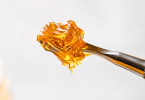







So what is shatter? It’s a butane hash oil concentrate prized for its glass-like clarity and high potency, typically testing around 70 to 90% THC. It gets its name from its brittle, translucent texture: at room temperature it snaps and shatters like hard candy or a thin sheet of amber glass. What separates shatter from other butane hash oil (BHO) products isn’t a different extraction method but a different finish, since the same starting oil can be coaxed into shatter, wax, or budder depending on how it’s handled during the final purge.
What is Shatter Made Of?
Shatter is concentrated cannabis resin: the cannabinoids and terpenes pulled out of the plant and left behind once the solvent is removed. Those compounds come mostly from the trichomes, the tiny glandular structures that coat cannabis flower and produce most of its THC, other cannabinoids, and aromatic terpenes. (They’re sometimes loosely called “crystals” because they sparkle, but they’re resin glands, not actual crystals.) Stripping those glands’ contents away from the bulk plant material and concentrating them is what turns roughly 15 to 30% THC flower into a concentrate that commonly tests around 70 to 90% THC.
The trade-off in any concentrate is between potency and preserved terpenes. Many refinement steps can reduce terpene content, since the volatile terpenes that carry flavor and aroma are more easily lost during processing, though the exact profile depends on the extraction method and post-processing — a live-resin shatter, for instance, can retain far more terpenes than a heavily handled wax. Either way, how shatter is made matters as much as what it’s made from.
How is Shatter Made?
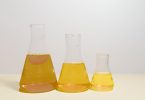
Shatter starts the same way as most BHO products: with hydrocarbon extraction. Liquid butane, sometimes blended with propane, is passed through packed cannabis material in a sealed system, dissolving the cannabinoids and terpenes and carrying them out of the plant matter as a golden solution. That solution then goes through purging, where controlled heat and vacuum pressure drive off the residual solvent and leave concentrated oil behind.
The purge is where shatter becomes shatter. Left undisturbed and cooled slowly under vacuum, the oil stabilizes into the flat, translucent, brittle sheet that gives the product its name. Agitation is the enemy of clarity here: whipping or stirring the same oil during purging introduces microscopic air bubbles and changes in the resin’s internal structure that turn it opaque and soft, producing wax or budder instead. So the difference between a slab of glassy shatter and a tub of wax is largely a matter of temperature and handling, not a different plant or a different solvent.
This is also why shatter has a reputation for being technically demanding. The same batch that yields flawless glass in careful hands can turn cloudy or unstable if the temperature drifts or the oil is disturbed at the wrong moment.
What Makes Shatter Different From Wax?
Texture and stability, mostly. Shatter’s undisturbed, glassy structure tends to be more stable and slower to degrade than wax, provided it’s stored cool and protected from heat and oxygen — shatter can still “sugar up” and turn grainy over time, especially if it’s warm or terpene-rich. It’s also harder to handle and portion than wax, since it’s stiff at room temperature and can snap unpredictably. Wax and budder are softer and easier to scoop onto a dab tool, but their whipped, air-incorporated structure can make them slightly less shelf-stable. Neither is inherently more potent than the other — they’re the same oil finished two different ways, one left to set into glass and the other whipped to incorporate air. For a deeper look at how that whipped texture is produced, see our companion piece on BHO wax.
Is Shatter Safe?
Properly made and lab-tested shatter is safe to use, but the “properly” is doing real work in that sentence. Because it’s made with a flammable hydrocarbon solvent, shatter has to be purged thoroughly and then verified by testing to confirm the butane has actually been removed to safe levels. In regulated markets, concentrates are screened for residual solvents using gas chromatography. Testing commonly follows a standard such as ASTM D8244, while the actual solvent limits are often derived from USP <467>, the pharmaceutical standard for residual solvents, which sorts them by risk. The gap between those limits is striking: benzene, a Class 1 carcinogen with no safe exposure threshold, is held at around 2 parts per million, while n-butane, treated as far less hazardous, is permitted at much higher levels — up to 5,000 ppm in states like Colorado. A professionally purged shatter clears these thresholds comfortably; the danger lies almost entirely in unregulated, untested product and in amateur “open-blasting” extraction, which has caused numerous fires and injuries and is illegal for good reason.

The practical takeaway for consumers is the same as for any BHO product: the certificate of analysis is what separates a verified-clean concentrate from a claim. A batch-specific lab report confirming potency and residual-solvent screening is the only reliable way to know what you’re actually dabbing.
How Do You Use Shatter?
Shatter is most commonly consumed by dabbing — vaporizing a small amount against a heated nail or in an electronic dab rig — though it can also be used in concentrate-compatible vaporizers or broken up and added on top of flower in a bowl or joint. Because it’s several times more potent than flower, a little goes a long way: a dose the size of a crumb can deliver more THC than a whole bowl of flower, so anyone new to concentrates should start with far less than feels intuitive and adjust from there.
This article is part of T&T’s complete guide to BHO extraction, covering how butane hash oil is extracted, purged, and finished into its various forms.
Originally published 2018. Updated July 2026 with current potency figures, residual-solvent testing standards, and a clearer explanation of how shatter differs from wax.
Image Sources