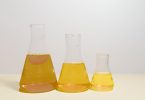







Well-made live resin can come remarkably close to the aroma of the living cannabis plant it came from. The approach behind it is straightforward: instead of drying and curing the flower before extraction — the steps that quietly alter and diminish its aroma — the cannabis is frozen immediately after harvest and kept cold throughout storage, handling, and extraction. What survives is a concentrate that holds much more of the volatile terpene chemistry present at harvest, which is why well-made live resin is often among the most aromatic concentrates on the shelf.
The aroma of a flowering cannabis plant is distinct, to say the least, and much of what makes it so is fragile — easily dulled between harvest and the finished product. Live resin exists to keep as much of it intact as possible.
Why Does Fresh-Freezing Preserve So Much More Flavor?
The answer lies in how terpenes behave, because they’re far more delicate than the cannabinoids they accompany. Terpenes and other aroma compounds have relatively high vapor pressures, meaning they can gradually escape into the air well below their boiling points. Heat accelerates that loss, while oxygen and light can oxidize or transform parts of the volatile profile. Conventional drying and curing exposes the flower to exactly those conditions over days or weeks, and it can substantially alter a flower’s volatile profile — although the amount lost varies widely by cultivar, drying method, and processing conditions, and relatively few controlled studies have pinned down the extent.
Freezing the plant quickly after harvest slows many of those changes and limits the time available for volatile compounds to escape. The trichomes — the resin glands that hold the terpenes and cannabinoids — are held close to their state at harvest, and keeping the biomass and solvent cold during extraction further reduces losses, although no extraction or purging process preserves every compound present in the living plant. In practice, live resin often carries a higher total terpene concentration and a broader volatile profile than comparable extracts made from dried material, even if the exact figures vary considerably from one product to the next.
What Makes Live Resin Different From Other Concentrates?
The starting material, not the solvent. Live resin is still made with light hydrocarbons — butane, or a butane-propane blend — the same solvents behind shatter and wax. What sets it apart is that the input is fresh-frozen rather than dried, and that the whole extraction is run cold to protect the terpene load. In practice, that also means live resin is purged more gently, at lower temperatures, since an aggressive high-heat purge would drive off the very compounds the process exists to save.

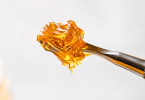
Photo by Preferred Organic Therapy
That terpene-rich makeup is why live resin rarely arrives as a hard, glassy slab. It shows up in a range of consistencies — runny sauces, grainy sugars, softer badders. Higher terpene content often contributes to a wetter, more fluid consistency, but texture also depends on cannabinoid composition, THCA crystallization, purge conditions, agitation, and storage. For how those variables play out, our guide to how closed-loop butane extraction works covers how purge conditions shape consistency, and our pieces on shatter and BHO wax cover the firmer end of the spectrum.
One point of frequent confusion worth settling: live resin is not live rosin. The names are nearly identical and both begin with fresh-frozen cannabis, but their processing diverges immediately. Live resin is commonly extracted with butane or a butane-propane blend. Live rosin is usually made by washing the frozen material into ice-water hash and then pressing that hash with heat and pressure — a solventless route that tends to carry a higher price for its more labor-intensive process.
A Short History: Colorado, 2013
The modern commercial form of live resin is generally credited to a small group of Colorado extractors working around 2011 to 2013. A few attempted fresh-frozen BHO as early as 2011 using open-blasting methods, with unsatisfying results. According to the industry history most frequently cited, the breakthrough came in 2013, when grower and hash-maker William “Kind Bill” Fenger worked with Jason “Giddy Up” Emo, founder of EmoTek Labs, at the Colorado Springs facility of a medical dispensary called A Cut Above. Using EmoTek’s closed-loop extraction unit — equipment capable of holding the very low temperatures the process demands — they ran frozen material until they had a stable, aromatic concentrate, and Fenger is credited with coining the name “live resin.” From there it spread quickly to legal markets nationwide.
Does Live Resin Actually Get You Higher?
This is where the popular story tends to run ahead of the evidence. Live resin’s rich terpene content is often said to produce a fuller, more pronounced high through the “entourage effect” — the idea, popularized by Ethan Russo’s 2011 paper “Taming THC”, that terpenes and cannabinoids interact to shape the overall experience. It’s a plausible but broadly defined hypothesis, with evidence that varies depending on the compounds, doses, and biological mechanism being studied.
The picture emerging from human research is mixed rather than simply absent, and it’s more specific than “terpenes make it stronger.” In one small double-blind study from Johns Hopkins, vaporized d-limonene — a citrus terpene abundant in many cannabis strains — significantly reduced several measures of THC-induced anxiety when the two were inhaled together, in a dose-dependent way. Notably, d-limonene did not significantly alter most of THC’s other subjective, cognitive, or physiological effects measured in the study; its clearest effect was on anxiety. That’s evidence for one particular interaction — a terpene softening a specific unwanted effect — not proof that a terpene-rich extract automatically produces a stronger or more complex high. Many experienced consumers do report that high-terpene live resin feels different from a flavorless distillate at the same THC percentage, but whether that reflects a measurably different high or simply a more pleasant, more aromatic one is a question the research hasn’t settled.
Judging Quality
Because the whole value of live resin is its preserved terpenes, the certificate of analysis matters here — but it’s important to understand what it can and can’t tell you. A batch-specific COA can confirm the product’s measured terpene and cannabinoid concentrations and show whether it passed the required residual-solvent and contaminant tests. What it usually cannot prove is whether the biomass was genuinely fresh-frozen, whether the terpenes came from that specific batch, or whether cannabis- or botanically-derived terpenes were added after extraction. For that, buyers also have to rely on transparent labeling and trustworthy manufacturing information.
It’s also worth putting first things first: the residual-solvent, pesticide, and microbial screening matter more than the terpene percentage. A product can show a beautiful terpene panel and still be poorly manufactured. And more terpene is not automatically better — an unusually high number can make for a powerful aroma, but balance, freshness, and accurate labeling matter more than chasing the largest figure on the panel.
Live resin isn’t a guarantee of superior quality, potency, or effects. It’s a processing approach designed to preserve more of the volatile chemistry present at harvest. When the starting material, extraction, and storage are handled well, the result can capture aromas that drying and curing would otherwise alter or lose — and that sensory difference, rather than an automatically stronger high, is live resin’s clearest advantage.
This article is part of T&T’s complete guide to BHO extraction, covering how butane hash oil is extracted, purged, and finished across its various forms.
Originally published April 2017. Updated July 2026 with corrected terpene science, verified origin history, a current look at entourage-effect research, and a more accurate account of what lab testing can confirm.