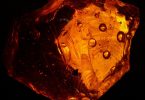







Guaiol is a sesquiterpenoid alcohol that occurs in certain cannabis plants, and in trees like cypress pine and especially guaiacum. It is known for a woody, piney aroma, sometimes described as having rose-like or tea-like edges. It is also, unusually for a cannabis terpene, a crystalline solid at room temperature rather than an oil – a detail that matters more than it sounds, as we’ll get to below.
History
Guaiol’s history isn’t as an individual terpene but rather entwined with guaiacum. After the Spanish reached Santo Domingo, they brought the tree back to Europe, where its resin – sold as “holy wood” – was famously believed to cure syphilis. [1] It did not work, as Paracelsus pointed out at the time, and physicians eventually moved on. It is a fitting origin story for this terpene: a remedy that became famous well before anyone checked whether it did what people said.
What the Research Actually Shows
Antibacterial activity. A 2007 study tested guaiol against six bacterial strains, including E. coli, S. aureus, and Salmonella typhi. Guaiol produced inhibition zones comparable in size to those produced by the control antibiotic imipenem against some of the tested organisms; derivatives of guaiol produced by microbial transformation were screened alongside it. [2] That does not establish equivalent potency, much less clinical usefulness, but it is genuinely guaiol-specific laboratory evidence – which is more than can be said for much of what circulates about this terpene.
Anticancer potential, in cells and mice. A 2016 study found that guaiol inhibited non-small cell lung cancer, both in cultured cells and in mouse xenografts, by destabilizing RAD51 – a protein cancer cells rely on to repair their DNA – through an autophagy-dependent route, pushing the cells toward apoptosis. [3] That is a real and interesting mechanism. It is also entirely preclinical: cells and mice, not humans, at experimental exposures that have not been shown achievable through ordinary cannabis use.
A natural insecticide. In 2013, researchers identified guaiol as a naturally occurring insecticidal sesquiterpene – less relevant to consumers, but a reminder that chemical defense is one of the ecological roles terpenes can play in plants, alongside signaling, pollinator attraction, and other functions. [4]
And one wrinkle. Terpene write-ups tend to assume every compound is a wellness ingredient. Guaiol offers a counterexample: a 2018 analysis paired 442 medical cannabis patients’ anxiety-relief ratings with laboratory chemotyping of the four highest- and four lowest-rated products from a single producer, and found guaiol among the terpenes significantly correlated with less anxiety relief. [5] It says very little about guaiol itself – guaiol appeared only at low concentrations in the products rated least effective, and the observational design cannot show that guaiol caused the difference – but it cuts against the everything-is-therapeutic reflex, and that makes it worth knowing.
Guaiol in Cannabis Varieties
Lists of guaiol-rich cultivars circulate – Chocolope, Liberty Haze, Blue Kush, and various Gorilla and Diesel lines among them. Treat them as folklore until a certificate of analysis says otherwise: strain names are unreliable guides to chemistry, and guaiol levels vary with the cultivar and how it was grown. One chemotyping study found higher concentrations of guaiol, β-myrcene, β-eudesmol, α-eudesmol, and α-bisabolol in CBD-dominant plants – a pattern within one dataset, not a rule for every CBD-rich chemovar. [6] If guaiol is what you’re after, the terpene panel on a COA is the only list that counts.
About That Famous “92°C Boiling Point”
Nearly every guaiol write-up on the internet repeats the same specification: boiling point, 92°C – often followed by advice to use a low vaporizer temperature to “target” the terpene. The problem is that 92°C is guaiol’s melting point. Guaiol is a crystalline solid at room temperature – borneol is another of the few cannabis terpenoids that forms crystals – and reference values place its melting point around 91–93°C. [7]
Reference data place its melting point around 91–93°C, while its reported boiling point at atmospheric pressure is approximately 288°C, with slight decomposition. [7] Whatever the precise value under different pressures, 92°C is not its normal boiling point.
The online figure therefore appears to reflect confusion between melting and boiling – although tracing the error to its original source is difficult. Either way, vaporizer advice built around 92°C has no reliable physical basis. It is exactly the lesson of our audit of cannabinoid boiling points: a widely repeated number is not necessarily a well-sourced one.
Guaiol is far from the most abundant or most studied cannabis terpene. But between real antibacterial data, a genuinely interesting preclinical cancer mechanism, an inconvenient anxiety correlation, and a physical constant the whole internet copied wrong, it makes a good case for the way this magazine tries to cover terpenes: what the studies actually tested, and nothing more.
References
- Frith J. Syphilis – Its Early History and Treatment Until Penicillin, and the Debate on its Origins. Journal of Military and Veterans’ Health. 20(4).
- Choudhary MI, Batool I, Atif M, Hussain S, Atta-ur-Rahman. Microbial transformation of (−)-guaiol and antibacterial activity of its transformed products. Journal of Natural Products. 2007;70(5):849–852.
- Yang Q, et al. (−)-Guaiol regulates RAD51 stability via autophagy to induce cell apoptosis in non-small cell lung cancer. Oncotarget. 2016;7(38):62585–62597. doi:10.18632/oncotarget.11540
- Liu T, Wang CJ, Xie HQ, Mu Q. Guaiol – a naturally occurring insecticidal sesquiterpene. Natural Product Communications. 2013;8(10):1353–1354. doi:10.1177/1934578X1300801001
- Kamal BS, Kamal F, Lantela DE. Cannabis and the Anxiety of Fragmentation – A Systems Approach for Finding an Anxiolytic Cannabis Chemotype. Frontiers in Neuroscience. 2018;12:730. doi:10.3389/fnins.2018.00730
- Jin D, Henry P, Shan J, Chen J. Identification of Chemotypic Markers in Three Chemotype Categories of Cannabis Using Secondary Metabolites Profiled in Inflorescences, Leaves, Stem Bark, and Roots. Frontiers in Plant Science. 2021;12:699530. doi:10.3389/fpls.2021.699530
- (−)-Guaiol, CAS 489-86-1, chemical reference data: melting point 91–93°C (lit.); reported boiling point ≈288°C at atmospheric pressure (with slight decomposition).
Last updated September 2026 · Originally published December 12, 2018.
Scientifically reviewed by Chana Frenkel, Ph.D